







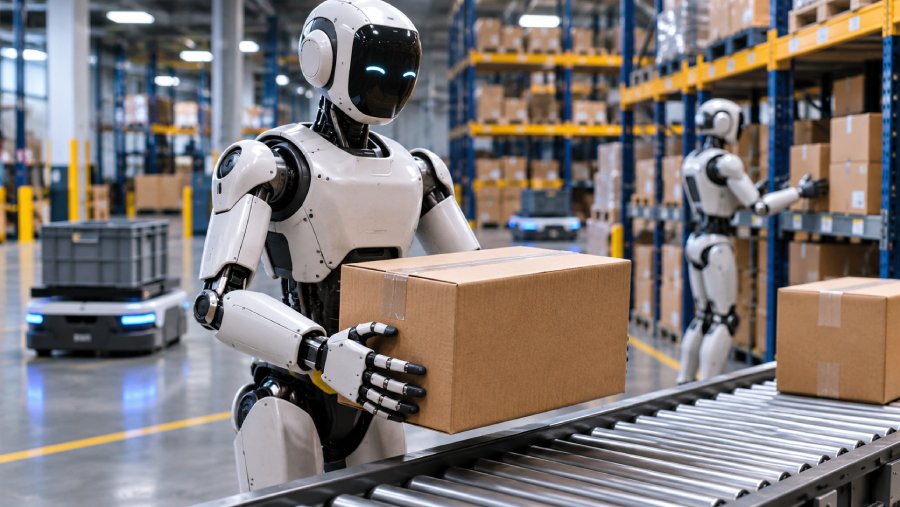
A thousand humanoid robots make an ambitious warehouse plan. For GXO, getting there depends on whether Apptronik’s Apollo can deliver reliable work.
GXO Logistics and Apptronik announced a letter of intent on Nov. 12 to expand real-world trials starting in 2027. Initial North American deployments are targeted for late 2027, with a possible global rollout of up to 1,000 robots over four years if they meet jointly agreed productivity, safety, and operational targets. Warehouse operators will be watching completed tasks, downtime, and on-site safety as closely as the planned fleet size.
Apollo's 1,000-robot plan starts with expanded trials
Under the agreement, GXO and Apptronik will test goods-to-person and person-to-goods picking, case and tote movement, packing, and sortation. They also intend to assess technical and security requirements, plus how the robots work alongside people and existing automation.
The partners began collaborating in 2024. GXO said a US pilot completed earlier in 2026 focused on autonomously picking small consumer goods.
Apptronik CEO Jeff Cardenas described the work as "measured against real operational KPIs in live facilities" in GXO's Nov. 12 announcement.
The announcement does not specify the performance thresholds Apollo must meet. Although GXO called the earlier pilot successful, the announcement did not provide enough data to assess how Apollo performs against existing warehouse automation.
Apollo 2 adds features that warehouses still need to test
Apptronik introduced Apollo 2 and a nearly 90,000-square-foot Robot Park this summer. The robot comes in wheeled and bipedal configurations, while the training facility combines teleoperation with autonomous execution to gather data for robotics models developed with Google DeepMind. That work connects Apollo to Google’s broader push to give humanoids more capable AI control.
Apptronik also describes swappable batteries, proximity-based safety controls, and Fleet Connect software for monitoring and coordinating robots.
The company is positioning Apollo for physically demanding, repetitive work in industrial settings. However, features such as extended operation and safe human interaction still need validation under the conditions GXO expects its robots to handle.
According to Apptronik's Robot Park announcement, Apollo 2 training data will inform development of its next commercial model, Apollo 3. GXO has not identified which Apollo hardware generation or mobility configuration it intends to deploy.
For warehouse operators, the unanswered questions include how the robots handle unusual items, navigate shared workspaces, and recover when a task fails.
Service costs and reliability will shape the rollout
GXO expects the commercial arrangement to use a Robotics-as-a-Service model, allowing warehouse operators to obtain robot capacity through a service contract rather than purchasing every machine outright.
The announcement does not disclose pricing, maintenance responsibilities, or service-level commitments.
A larger deployment would also require the robots to work with existing warehouse systems, including conveyors, inventory software, and other automated equipment.
For operators already investing in automation, the commercial decision will depend on whether the robots can perform useful work consistently without adding excessive supervision, maintenance, or integration costs.
What eWeek found: GXO has Digit results, but few Apollo metrics
Apollo isn't the first humanoid robot GXO has put to work in a warehouse. Its existing partnership with Agility Robotics offers a useful comparison.
GXO and Agility report that Digit robots have moved more than 100,000 totes at GXO’s Flowery Branch, Georgia, facility. Since 2024, the robots have worked alongside existing automation, moving containers onto conveyors.
Digit is also scheduled for deployment at two additional US facilities in early 2027. Agility reported more than 65,000 operating hours across its broader commercial deployments and customer programs, although that total is not specific to GXO.
Agility is also targeting longer operating days with its next-generation Digit, making endurance another development to watch.
Apollo, meanwhile, has less publicly available performance data. Its US pilot focused on picking small consumer goods, while evaluations at Apptronik's Robot Park covered more than 50 logistics tasks. However, the companies' Nov. 12 announcement did not disclose picking speeds, sustained uptime, or how often workers needed to intervene.
Measure | Apptronik Apollo | Agility Digit |
| Deployment status | Completed GXO pilot; expanded trials planned for 2027 | Commercial GXO deployment since 2024 |
| Published activity | More than 50 logistics tasks evaluated at Robot Park | More than 100,000 totes moved at one GXO facility |
| Expansion plans | Up to 1,000 robots, subject to performance targets | Two additional GXO facilities planned for 2027 |
| Public performance gaps | Nov. 12 announcement provides no hourly output, uptime, or intervention rates | Cumulative tote count disclosed, but no directly comparable hourly productivity or cost figures |
The figures do not show which robot performs better. Digit moves containers, while Apollo's GXO pilot focused on picking smaller products. Comparing their results would be misleading because they perform different warehouse tasks.
GXO's next trials should help warehouse operators answer three questions about Apollo:
- How many products can it pick per hour?
- Can it work through an entire shift without frequent stops?
- How often will employees need to step in?
Cost is another concern. Service fees, maintenance, charging, and supervision can add up. If workers frequently need to stop their own tasks to assist a robot, the expected savings may not justify the investment.
For the broader humanoid robotics market, GXO’s trials could provide evidence beyond demonstrations and fleet targets. The useful measure will be completed work after accounting for downtime, errors, and human assistance. A successful rollout would show whether Apollo’s capabilities can translate into repeatable commercial value across warehouses.
Also read: Explore how Tesla, Figure AI, and Agility are preparing humanoid robots for real-world deployment in 2027.