







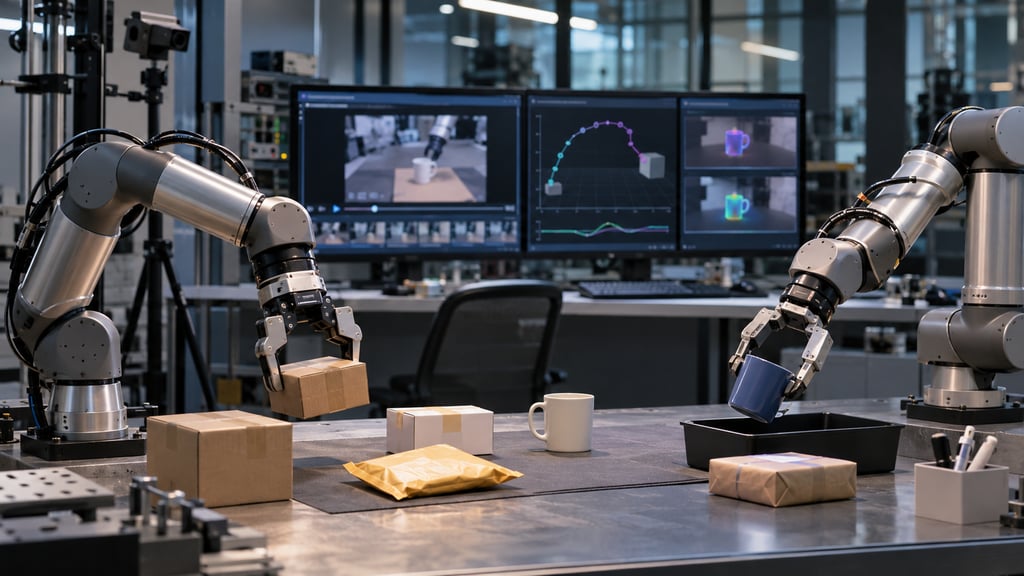
Runway has spent years teaching AI to make things move on screen. Now it wants to see if those skills can help robots move things in the real world. Hollywood, meet the factory floor.
On Nov. 11, the company released its Praxis-1 robotics model for commercial use, complete with model weights, inference code, and fine-tuning tools under the Apache 2.0 license. The 27.2-billion-parameter system combines video prediction with robot action generation, giving developers a way to adapt its capabilities to different machines.
For robotics companies and manufacturers, the promise is enticing: robots that can learn new tasks with less hardware-specific training data. But there's a catch. Making a robot look impressive in a controlled test is one thing. Getting it to survive a full shift on the factory floor without fumbling the job is another.
Runway makes Praxis-1 available beyond its partners
In its Nov. 11 announcement, Runway said developers can obtain Praxis-1 through Hugging Face, use the GitHub repository, or access hosted inference through Reactor. The release includes code for full fine-tuning and the less resource-intensive Low-Rank Adaptation (LoRA) method.
Runway introduced Praxis-1 in September and worked with Noble Machines, Standard Bots, and Ultra on different robotic systems, including an industrial arm, a dual-arm warehouse robot, and a legged humanoid.
The November release lets other developers test the model on their own equipment rather than limiting access to the initial partners.
The downloadable options include checkpoints trained for a single-arm DROID setup and a two-arm YAM robot, plus a base model for adaptation. The base model cannot operate a new robot immediately: Runway's implementation notes say it lacks the robot-specific action heads needed to issue commands.
Developers must add and train those components for their hardware.
Apache 2.0 allows commercial use of Runway's released weights and software, but the supporting Wan2.2 and Qwen3.5 components have separate licenses that developers must review.
How a video model learns to move a robot
Praxis-1 is a 27.2-billion-parameter mixture-of-experts model that builds on Runway's video-generation research. Rather than learning solely from people remotely operating robots, it first learns how objects move and interact through ordinary video, then combines that knowledge with robot demonstrations during training.
According to Runway's technical report, the model receives an instruction, camera views, and the robot's current position. It predicts what the scene should look like next and generates 1.6 seconds of movements, represented by 24 actions at 15 updates per second.
The robot executes those movements, observes the result, and repeats.
The aim is to reuse visual knowledge across different machines, while fine-tuning the controls for each robot's cameras and joints. Runway's model joins a wider push into physical AI training and simulation. Unlike NVIDIA's reference humanoid robot project, Praxis-1 supplies an adaptable control model rather than a standardized robot platform.
Praxis-1's tests show progress, with limits
Runway reported that Praxis-1 completed 555 of 1,200 simulated trials on NVIDIA's RoboLab-120 benchmark, a 46.2% success rate across 120 tabletop tasks. In its comparison, FLUX 3 Action reached 42.9%, Cosmos3 Nano 36.8%, and pi0.5 28.0%.
Those figures do not make Praxis-1 the overall top-ranked system across every category. NVIDIA's public leaderboard lists some agent-based and closed models above 46.2%. It also did not display a Praxis-1 entry when reviewed on Nov. 13, so the model's published score and claimed placement remain attributed to Runway rather than independently confirmed here.
There is physical-robot evidence, too. Runway said Praxis-1 completed 88 of 100 trials on ten single-item tasks with a Franka FR3 robot, compared with 80 of 100 for FLUX 3 Action under the same test setup. The company ran those trials on Nov. 2; their scope is much narrower than the varied tasks a commercial robot might face.
What eWeek found: Praxis-1 shows promise, but real-world reliability remains unproven
Runway's technical report presents encouraging results, although the tests cover different environments and levels of complexity. Comparing them reveals how much of Praxis-1's performance has been demonstrated on physical robots and how much remains confined to simulation.
Evaluation | Praxis-1 result | What remains unproven |
|---|---|---|
RoboLab-120 simulation | 46.2% success across 1,200 trials | Reliability in a working warehouse or factory |
Physical Franka arm | 88 successful trials out of 100 across ten single-item tasks | Performance on longer, unpredictable jobs |
Noble Machines warehouse simulation | 6 successful trials out of 10 on a harder, unfamiliar task after adaptation | Performance on the physical Noble Machines robot |
The Noble Machines experiment offers an example of the model's adaptability. Runway reported fine-tuning Praxis-1 using just 29 minutes of robot demonstrations.
After approximately 3.6 hours of training on 16 GPUs, it completed all 15 simulated trials in familiar layouts but succeeded in only six of ten trials involving a harder, previously unseen warehouse task.
The experiment demonstrated how quickly Praxis-1 could adapt to a new robotic system, although the reported results did not include testing on the physical Noble Machines robot.
Computing requirements present another obstacle. Runway's GitHub documentation specifies an NVIDIA GPU with at least 80 GB of memory for the default setup. Optional four-bit inference reduces the model's memory requirements, but Runway cautioned that performance under reduced precision requires additional validation.
The company also acknowledged difficulties with similar-looking objects, ambiguous instructions, and tasks requiring several actions. A robot that selects the wrong item or struggles with a longer sequence could interrupt operations that depend on consistent performance.
Taken together, the results show that Praxis-1 can perform useful robotic tasks and adapt to different hardware with relatively little training data. However, the available testing does not yet establish how reliably the model would perform during continuous commercial operations.
What enterprises should consider before deploying Praxis-1
For manufacturers, warehouse operators, and robotics developers, Praxis-1 could provide another approach to automating tasks that require machines to recognize and manipulate different objects.
A warehouse operator, for example, could test whether the model can handle products with varying shapes, packaging, and positions without extensive reprogramming. However, the cost of adapting the model and maintaining reliable performance would need to justify replacing or supplementing existing automation.
Businesses considering Praxis-1 should evaluate three areas before committing to deployment:
- Performance in real operating conditions: Test the model with unfamiliar objects, changing lighting, and repeated tasks. Measure successful operations, incorrect picks, recovery time, and how often employees must intervene.
- Infrastructure and operating costs: Account for compatible robotic hardware, GPU resources, model fine-tuning, software integration, and maintenance. Commercial licensing allows developers to use and modify the released model, but running it still requires computing resources and technical expertise.
- Safety and human oversight: Establish procedures for unexpected movements, failed tasks, and unclear instructions. Test emergency stops, operator intervention, and recovery procedures before considering unattended operation.
Companies should also compare Praxis-1 against their existing robotic systems. For repetitive tasks with predictable conditions, conventional automation may remain more practical and economical. AI-based control could offer greater flexibility when objects, layouts, or task requirements frequently change.
The NVIDIA-backed GRID robotics development platform also illustrates the importance of evaluating robots through simulation and physical testing before deployment.
Runway's release makes Praxis-1 easier for developers to experiment with. The larger question is whether models trained to understand movement through video can eventually deliver the consistency required to control machines in everyday industrial settings.
AI is moving beyond chatbots and into the physical world. Want to build your own AI skills? Start with The Neuron Academy's free six-minute How to Talk to Your AI course, then explore more AI lessons with seven days of free access.