






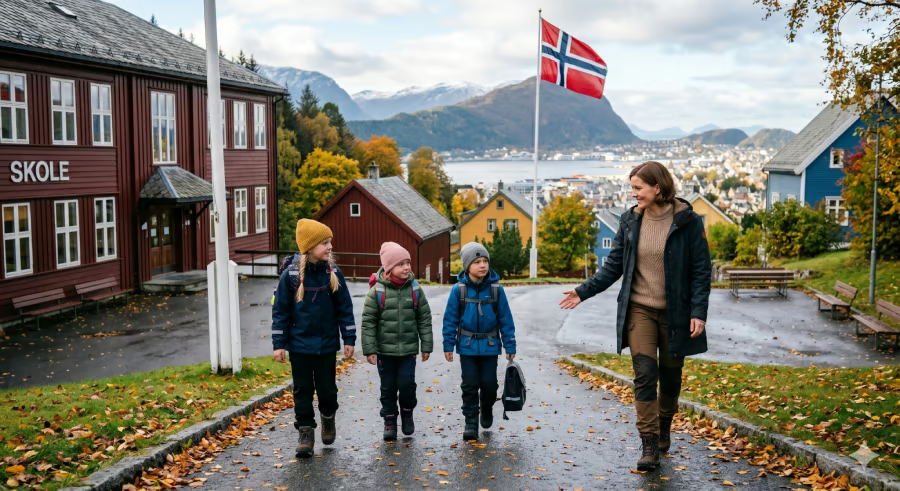


Norway is imposing strict new limits on generative AI in elementary schools to protect basic learning skills in the classroom.
The government will impose a near ban on AI tools for pupils in first through seventh grade, covering children ages 6 to 13, when the new school year begins in late August. Prime Minister Jonas Gahr Støre said AI can increase the risk that young children skip important steps in learning to read, write, and do mathematics.
Older students will face looser rules. Lower secondary pupils, ages 14 to 16, may use AI only under teacher supervision, while upper secondary students are expected to learn how to use the technology appropriately for further education and work.
Norway puts AI limits on young pupils
Reuters reported that Norway is imposing a near ban on the use of generative AI tools by elementary school pupils, while restricting how older children can use the technology in class.
“The most important thing in school is that our children learn to read, write, and do mathematics,” Støre said at a press conference.
The rules will apply from the new school year beginning in late August. Pupils in first through seventh grade, ages 6 to 13, should generally not use AI tools. Students in lower secondary school, ages 14 to 16, may use AI cautiously under teacher supervision.
For upper secondary students, ages 17 to 19, Norway’s government said schools should teach the appropriate use of AI so students are prepared for further education and work.
Norway is pulling back from classroom tech
The AI restrictions follow other moves by Norway to reduce children’s reliance on digital devices in school and online.
According to Reuters, Norway banned smartphones from schools in 2024 after a broad decline in education test scores. The government also gave teachers more authority to enforce classroom discipline.
Engadget noted that the smartphone policy led to lower bullying, better grades, and fewer psychologist visits for mental health issues, with especially strong results among girls.
Norway is also moving back toward more traditional learning materials. Reuters said that the government plans to propose legislation to fund more books in classrooms, reversing years of increased reliance on computers and tablets.
That move marks a notable turn for a country that adopted computers in classrooms in the 1990s and tablets after the iPad arrived in 2010.
Europe keeps tightening rules for children online
Norway’s AI policy is part of a broader European debate over how much digital technology children should use at school and online.
The country announced plans in April to ban children from using social media until they turn 16. Reuters highlighted that the move follows a trend pioneered by Australia and other countries trying to reduce young people’s use of electronic devices.
For European schools, the policy raises a familiar tension.
AI tools can help students summarize, brainstorm, translate, and draft. They can also make it easier for younger children to bypass foundational skills before they have learned them.
Norway’s approach draws a line by age instead of treating all students the same. Younger pupils are largely kept away from generative AI, teenagers get more controlled access, and older students are expected to learn how to use the technology responsibly before university or work.
The age-based structure could become a model for other European education systems still deciding how far AI should go in classrooms.
It also shows that AI policy in schools is moving beyond plagiarism and chatbot detection. In Norway, the question is whether young students are developmentally ready to use AI without weakening the basic skills schools are supposed to build first.
Read more: Norway is also moving to keep kids under 16 off social media as part of its wider push to limit children’s exposure to digital platforms.