








Adobe is expanding Acrobat from a tool for reading and editing PDFs into an agentic productivity platform designed to help people understand, share and create from large collections of organizational documents.
On Sept. 9, the company introduced two new enterprise capabilities powered by its Adobe productivity agent:
- Knowledge Base lets teams ask questions across large collections of business content
- Analyzer extracts structured information from thousands of documents for analysis and action
The launch builds on Adobe's broader effort to reinvent Acrobat around AI. eWeek previously covered Adobe's introduction of Acrobat Studio, which brought Acrobat, Adobe Express and customizable AI assistants into a shared workspace.
The latest additions push that strategy further into enterprise knowledge work. Rather than requiring employees to manually search through individual contracts, reports, presentations and other files, Adobe wants Acrobat to become an environment where AI can help readers better understand those materials and help turn what they find into insights and finished work.
Acrobat moves beyond the PDF
Adobe's new Knowledge Base is designed to give employees a natural-language interface for company information spread across different files and repositories. Teams can query collections containing PDFs, Microsoft Word, Excel and PowerPoint files, web content, text and email. Files can also be synchronized from Microsoft SharePoint and Google Drive so the information available to Acrobat stays current.
Adobe described Knowledge Base as an alternative to manually searching across repositories and opening documents individually. Responses are grounded in the source material and include citations that users can follow back to the original information to verify and dig more deeply.
That could make the technology particularly useful for businesses with large collections of internal policies, sales materials, research, technical documentation or other frequently referenced information.
Analyzer tackles a related problem: extracting useful data from large volumes of unstructured document data. Adobe said the tool can surface structured information from thousands of files for teams in finance, procurement, operations and IT. A vendor management team, for example, could use Analyzer to identify contract terms, service-level agreements, auto-renewal dates, inflation adjustments and reporting requirements across a portfolio of agreements.
Instead of treating each contract as an individual document, Acrobat can effectively turn the collection into a dataset employees can query and analyze.
From finding information to creating the deliverable
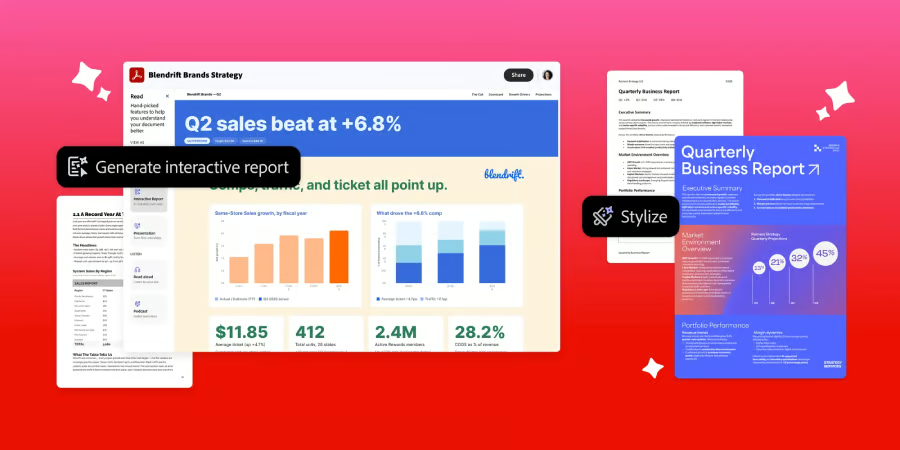
Adobe is also trying to connect document information with what comes next. Users can tap new visual and audio features in Acrobat to gain a deeper understanding of what’s inside for themselves, and create deliverables they can share with others.
For example, Acrobat can convert source materials into interactive reports, summary slides and presentations. Its new Stylize capability can take documents such as reports, invoices and resumes and reformat them using professionally designed Adobe Express templates while preserving the original content.
That connection between understanding information and producing something from it is central to Adobe's productivity agent strategy.
When Adobe first introduced the agent in May, it described an AI interface capable of orchestrating multiple tools and models to generate presentations, podcasts, and social posts, and supporting conversational PDF editing. Adobe's PDF Spaces provide a workspace where users can combine files, links, and notes for research and content creation through natural language.
The September release brings more enterprise content into that workflow. A user could theoretically move from asking questions across a company's document library to packaging the results into a presentation or report without leaving the broader Acrobat environment.
Read our earlier coverage of the broader transition from AI copilots toward systems capable of carrying out more of a workflow, an idea which Adobe's approach applies specifically to document-heavy work.
Enterprise documents are becoming AI context
Adobe isn't alone in seeing corporate files as a valuable foundation for enterprise AI. Microsoft's SharePoint agents can already answer questions using content from SharePoint sites, pages and document libraries, with responses limited by the requesting user's existing access permissions. Box has likewise been expanding AI capabilities designed to reason across enterprise content.
But for Adobe, the opportunity is closely tied to Acrobat's existing place in business workflows rather than building a new enterprise repository from scratch.
Adobe said more than 400 billion PDFs are opened in Acrobat each year. The company is now trying to make those documents — along with the Word files, spreadsheets, emails, and other related information — usable as context for AI-driven work.
That is a significant expansion of what Acrobat has traditionally been designed to do. Adobe itself now calls Acrobat a "document productivity platform," rather than simply a PDF tool. The company has also begun extending Acrobat capabilities into platforms including ChatGPT, Claude, WhatsApp, Chrome, and Edge.
Trust becomes part of the document AI pitch
Giving AI access to an organization's documents also introduces an obvious enterprise concern: whether sensitive information remains properly controlled.
Adobe said Knowledge Base provides clickable source citations and that customer document data is not used to train its generative AI models. The company is also pitching enterprise governance and security as part of Acrobat's AI offering, a need that is growing as document AI evolves beyond merely summarizing a PDF someone deliberately uploads.
An enterprise system capable of searching shared repositories and reasoning across thousands of documents may have access to contracts, financial information, personnel materials, intellectual property, and other sensitive data. Which documents an AI system can access — and whether employees can verify where its answers came from — could become as important as the quality of the generated answer.
Adobe's bet is that its longstanding position in document workflows gives it a place to build that layer.
Acrobat has spent decades helping businesses create, distribute and manage documents. With Productivity Agent, Knowledge Base, and Analyzer, Adobe is now trying to make those same documents something AI can work with, moving Acrobat from a place where employees open information to one where they can ask it to do more.
Also read: Explore Microsoft’s biggest Build 2026 announcements, from new AI agents to updates across its enterprise platforms.