







Shopping online can mean finding exactly what you want, then hunting for it again when you're ready to buy.
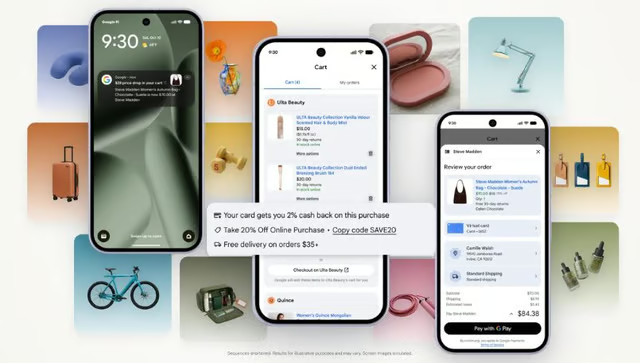
Google began rolling out Universal Cart on Oct. 15, giving US shoppers one place to save products from different retailers across Search and the Gemini app. Saved items remain accessible when shoppers move between the two services.
For retailers, the business question is whether easier product discovery leads to completed purchases. Universal Cart offers checkout within Google or a transfer to a merchant’s website, but the two routes have different limits on how shoppers manage their baskets.
Saved products stay visible as prices change
A Steve Madden handbag discovered through Search's AI Mode can join a Quince sweater found later in Gemini. Someone comparing gifts over several days can revisit both items without retracing their searches.
Google's Shopping Graph, containing more than 60 billion continually refreshed product listings, supports price-drop alerts and notifications when sold-out items return. Universal Cart can also identify relevant promotional codes, so shoppers can monitor their selections for a better price or the return of a preferred size without repeatedly checking individual stores.
Participating retailers handle the purchase
Checkout depends on the merchant and the product. Using the Universal Commerce Protocol, shoppers have two ways to complete eligible purchases:
- Google Pay checkout. Customers can pay for supported items within Universal Cart, with Google Wallet recommending saved payment cards based on available rewards.
- Retailer checkout. Shoppers can transfer selected products to a merchant's website and complete the transaction there.
According to the tech giant, Walmart, Sephora and Target support select checkout options, as well as participating Shopify stores. Retailers remain responsible for fulfilling orders and providing customer support, including purchase confirmations. Products from several stores may share a saved cart, although purchases are still processed by the respective merchants.
An earlier I/O preview also outlined plans to extend Universal Cart to Gmail and YouTube. Google’s Oct. 15 announcement did not specify when those integrations would launch.
What eWeek found: A shared cart has checkout limits
A review of Google’s documentation shows that saving products together and keeping retailer carts synchronized are separate capabilities. Its native-checkout documentation supports purchasing multiple products from one participating retailer in a single transaction. That differs from ChatGPT’s original Instant Checkout, which launched with support for single-item purchases. Google’s guide also says support for adjusting quantities within its interfaces is still forthcoming.
The separate Cart API supports a one-way transfer to a retailer’s website. Its initial release does not synchronize subsequent changes between Google and the merchant’s cart. The documentation therefore distinguishes a shared saved cart from a retailer basket that stays synchronized after transfer.
Walmart’s earlier partnership with OpenAI illustrates why these distinctions matter. Executive Daniel Danker told WIRED in March that purchases completed inside ChatGPT converted at approximately one-third the rate of products directing customers to Walmart’s website. He also described shoppers’ reluctance to buy items individually and concerns about separate deliveries. However, differences in product selection prevent attributing the conversion gap solely to checkout design.
At a March 4 investor conference, Danker described plans for Sparky within ChatGPT and Gemini to recognize products already in a customer’s Walmart cart and combine them into one order. Customers could also return later to complete the purchase in Walmart’s app. OpenAI subsequently acknowledged that its initial checkout approach lacked flexibility and shifted its focus toward product discovery while allowing merchants to use their own checkout experiences.
For retailers, the takeaway is to test basket continuity and purchase completion separately. Teams should check what happens when shoppers transfer a basket, change quantities on the merchant’s website and return to Gemini, including whether the interface makes clear which cart reflects those changes. They should also compare checkout abandonment across Google Pay and their own websites using comparable products and shopper groups. Multi-item support addresses a specific design limitation of the original Instant Checkout, but it does not establish that Google’s approach will produce better conversion.
Want to learn more AI tips, tricks, and prompting techniques? eWeek readers get free 7-day access to The Neuron Academy, our practical learning platform designed to help professionals use AI more confidently at work. Browse all lessons →
Let us teach you How to Talk to AI for free! Try our six-minute course at The Neuron Academy and learn a few simple ways to write better prompts and get more useful results from AI, or browse our other AI course for free for seven days. Check out all the lessons here →