







Singapore has spent years building quantum research expertise. Now it wants more of that science to escape the laboratory.
On Aug. 31, Singapore released its RIE2025 progress report alongside the RIE2030 Plan, providing a fuller picture of how the country intends to turn research into economic and national capabilities through 2030. Quantum technology is among the strategic areas Singapore has identified for continued development as it tries to connect researchers, infrastructure and businesses more closely.
Singapore originally unveiled the broader S$37 billion RIE2030 plan in December 2025, covering research and innovation across multiple fields. The newly released materials put greater detail around the country's next phase: converting those investments into technologies and industries with real-world impact.
Singapore wants quantum research to leave the lab
The RIE2030 plan places greater emphasis on translating research into economic and national outcomes, including stronger connections among universities, companies, entrepreneurs and investors.
Quantum has already been singled out as a strategic technology within that effort.
At Singapore's Quantum Industry Day in April, National Research Foundation Chairman Heng Swee Keat said the country's RIE2030 Quantum Thematic Plan would build on its existing National Quantum Strategy. The goal is to help Singapore capture future quantum opportunities while establishing a strategic niche in the global quantum supply chain.
Singapore is not starting from zero.
The government has established national programs spanning quantum computing, processor development, quantum-safe networking, quantum technology fabrication and sensing. These programs are designed to act as bridges between fundamental research and eventual deployment.
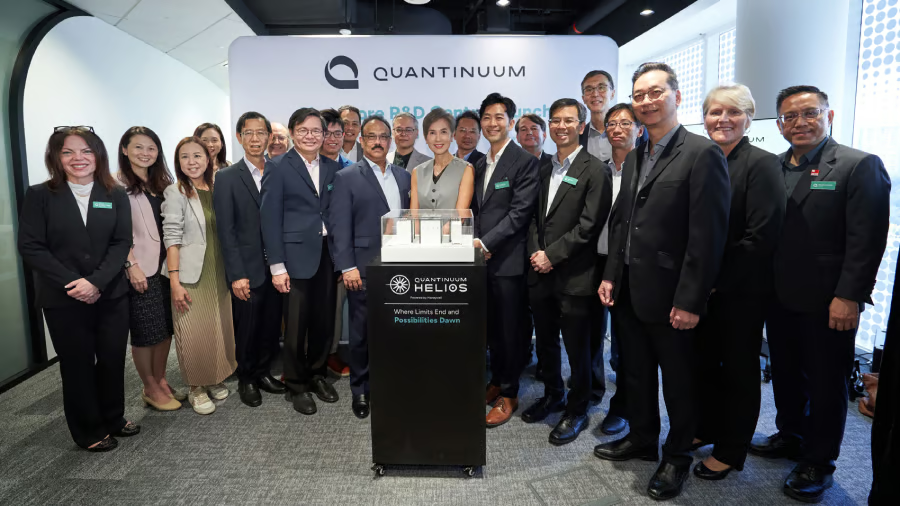
Singapore has also attracted commercial quantum players. Quantinuum established an R&D and operations center in the country earlier this year and plans to deploy a quantum computing system there, according to the National Research Foundation.
That fits a broader shift in the quantum industry toward bringing experimental machines closer to commercial infrastructure. As eWeek recently reported, Diraq plans to install a silicon-spin quantum computer in an Equinix data centre in Sydney, to test how quantum systems might eventually coexist with conventional computing infrastructure.
Banks are starting to test the business case
One of Singapore's clearest attempts to move quantum computing toward a practical application is happening in finance.
In July, UOB and the Centre for Quantum Technologies announced a collaboration examining whether quantum computing techniques could eventually improve the valuation of complex financial derivatives.
The initial project focuses on path-dependent financial instruments, whose values can depend on multiple market variables and historical price movements. These calculations frequently rely on large-scale Monte Carlo simulations involving thousands of possible market scenarios, making them computationally intensive.
Researchers will investigate whether quantum techniques could process large numbers of scenarios more efficiently under certain conditions.
The project does not demonstrate that quantum computers can already outperform classical machines at derivatives valuation. Instead, it is an attempt to determine where quantum algorithms might eventually provide a meaningful advantage.
That distinction matters as companies increasingly move beyond quantum demonstrations and start asking where the technology could produce measurable business value.
Singapore is building around the quantum computer, too
Singapore's strategy is broader than simply building processors with more qubits.
Researchers and startups are also working on the systems needed to reliably control quantum computers, another major obstacle to scaling the technology. Researchers from Nanyang Technological University and the National University of Singapore have developed quantum control technology that is being commercialized through the Singapore startup AQSolotl.
Control systems are an easily overlooked part of quantum infrastructure. As machines grow, they require increasingly sophisticated electronics, calibration, cooling, and software to keep their qubits operating reliably. Those infrastructure challenges are appearing throughout the quantum industry.
IBM, for instance, is developing a much larger modular cryogenic platform as part of its effort to build a fault-tolerant quantum computer. eWeek recently examined how IBM's giant quantum cooling system illustrates just how much infrastructure may be required to scale beyond today's experimental machines.
AI could also become part of that control layer. In another experiment, Anthropic's Claude helped QuEra develop software to recover from failed quantum-computer laser controls during testbed trials.
Together, those efforts illustrate why the quantum race is increasingly about more than qubit counts. The supporting hardware, software, and control systems may prove just as important.
Quantum security could arrive sooner than quantum advantage
Singapore is simultaneously preparing for a consequence of quantum computing that could become relevant to businesses much sooner: the need to replace cryptography vulnerable to future quantum attacks.
IBM and the Singapore Institute of Technology announced plans on Aug. 18 to establish a Quantum-Safe Centre by the end of 2026.
The planned center is intended to help organizations assess cryptographic risks, test quantum-safe technologies and develop skills needed to migrate toward post-quantum security.
That creates two very different timelines inside Singapore's quantum strategy.
One involves the long-term effort to make quantum computing commercially useful. The other involves protecting today's systems from a future in which sufficiently capable quantum computers could break widely used public-key cryptography.
Enterprises elsewhere are facing the same problem. Google Cloud has set a 2029 target for post-quantum cryptography readiness, although customers will still need to address their own applications, certificates, keys and systems.
What eWeek found: Singapore is building an ecosystem before quantum is ready
The most telling part of Singapore's RIE2030 quantum strategy is not the S$37 billion figure.
That money covers the country's entire research and innovation program, not quantum alone. Singapore said in April that S$295 million was set aside under RIE2025 to fund quantum research efforts under its National Quantum Strategy, giving some scale to the country's existing investment even though a quantum-specific RIE2030 allocation has not been disclosed.
What stands out instead is how many pieces of the quantum ecosystem are now developing at the same time:
- Research and infrastructure: Singapore already funds national quantum programs and is preparing to host a Quantinuum quantum computing system.
- Enterprise experimentation: UOB is working with the Centre for Quantum Technologies to test quantum approaches for complex derivatives valuation.
- Commercial technology: Singapore-based AQSolotl is commercializing quantum control technology developed by researchers at NTU and NUS.
- Quantum security: IBM and the Singapore Institute of Technology plan to establish a Quantum-Safe Centre by the end of 2026 to help organizations prepare for post-quantum cryptography.
- Industry development: Singapore's quantum strategy calls for stronger links between research and deployment, while the government has explicitly said it wants the country to develop a niche in the global quantum supply chain.
None of these developments proves Singapore has cracked commercially useful quantum computing. Fault-tolerant quantum computers capable of delivering sustained advantages on important commercial workloads remain under development globally.
But taken together, the projects point to a deliberate strategy: Singapore is preparing the research base, hardware access, startups, enterprise use cases and security infrastructure before quantum computing reaches maturity.
For companies watching the market, that may be more significant than any single qubit milestone. The eventual winners of the quantum race may be the countries that already have an ecosystem waiting when the technology finally becomes commercially useful.
Also read: As quantum computing advances, new TCG guidance outlines what IT buyers should verify when investing in quantum-ready hardware.