







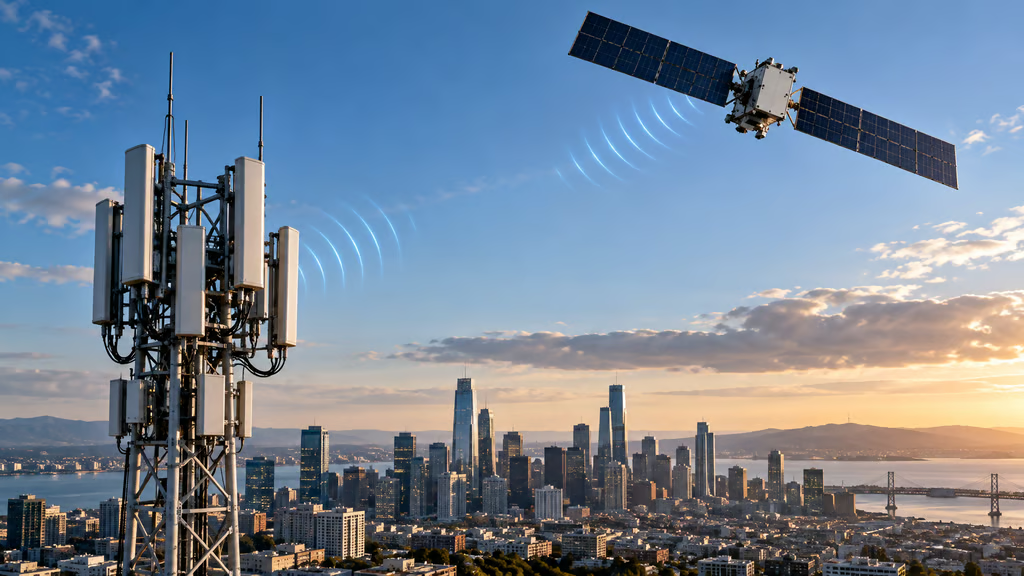
SpaceX already helps T-Mobile fill cellular dead zones. Now it wants Starlink Mobile to compete with America's largest wireless carriers.
The company announced an agreement to buy Grain Management's nationwide portfolio of up to 14 MHz of paired 800 MHz spectrum, pending Federal Communications Commission (FCC) approval. The company says the low-band frequencies can help signals reach phones inside buildings by combining satellites with a future terrestrial network.
For enterprises with remote sites or poor mobile coverage, the proposed service could create another option, although its launch timing and commercial terms remain unclear.
SpaceX bets on 800 MHz spectrum for indoor coverage
According to PCMag, the portfolio covers 817–824 MHz and 862–869 MHz, frequencies SpaceX says most existing smartphones already support. Financial terms were not disclosed. The FCC previously approved Grain's acquisition of T-Mobile's licenses, but the SpaceX-Grain transaction still needs approval.
The Verge reported that SpaceX plans to combine its satellites with ground-based cellular infrastructure, directly challenging AT&T, Verizon, and T-Mobile. The strategy could complicate its current relationship with T-Mobile, which offers the Starlink-powered T-Satellite service.
Engadget also said that the FCC authorized SpaceX to deploy 15,000 next-generation Starlink Mobile satellites optimized for 2 GHz spectrum. SpaceX says the new constellation could deliver more than 100 times the bandwidth of its current generation, although that remains a company claim rather than demonstrated network performance.
Satellite approvals leave major deployment hurdles
A comparison of the reported milestones shows that spectrum purchases, satellite authorizations, and a usable retail mobile service are separate steps.
Network component | Current status | Remaining hurdle |
800 MHz spectrum | Purchase agreed with Grain Management | FCC approval and ground-network buildout |
Gen2 satellites | 15,000 authorized for deployment | Satellite deployment and performance testing |
EchoStar 2 GHz spectrum | Separate acquisition agreement | Expected November 2027 closing; compatible phone chipsets |
T-Satellite | Offered through T-Mobile | Unclear partnership future and standalone retail launch |
Reliable urban coverage may require costly ground infrastructure
Satellite industry analyst Tim Farrar described the 800 MHz allocation as "a very limited amount of spectrum" and warned that SpaceX would need an extensive ground tower network to deliver reliable indoor service in cities. CNBC also noted that shares of AT&T, Verizon, and T-Mobile fell in extended trading following the announcement.
The FCC is separately considering a 25 MHz direct-to-device spectrum auction. On Oct. 29, it is also expected to consider seeking comments on making another 482 MHz available for satellite-backed coverage. Neither proposal approves the Grain transaction.
Starlink Mobile could expand enterprise connectivity options
Another hybrid carrier could eventually help companies connect remote facilities, support field employees, or improve backup communications in cellular dead zones. However, the supplied reporting does not specify a Starlink Mobile retail launch date, enterprise pricing, or service-level commitments.
Coverage, compatibility, and service readiness remain key concerns
Before adding Starlink Mobile to a connectivity plan, enterprise IT teams should assess:
- Coverage evidence: Verified signal quality at buildings and remote sites, plus reliability when switching networks.
- Commercial terms: Supported devices, pricing, technical support, and uptime commitments.
During contract renewals, businesses can document existing dead zones and compare currently available options, including the capabilities and limits of T-Mobile's T-Satellite service. SpaceX's spectrum deal is worth monitoring, but FCC clearance, tower deployment, and evidence of site-level performance should come before treating its planned retail network as a replacement for established carriers.
Also read: SpaceX is expanding beyond mobile connectivity. Its proposed $100 billion Starbase Louisiana project includes 10 launchpads, fuel production, and supporting infrastructure to scale future launches.