







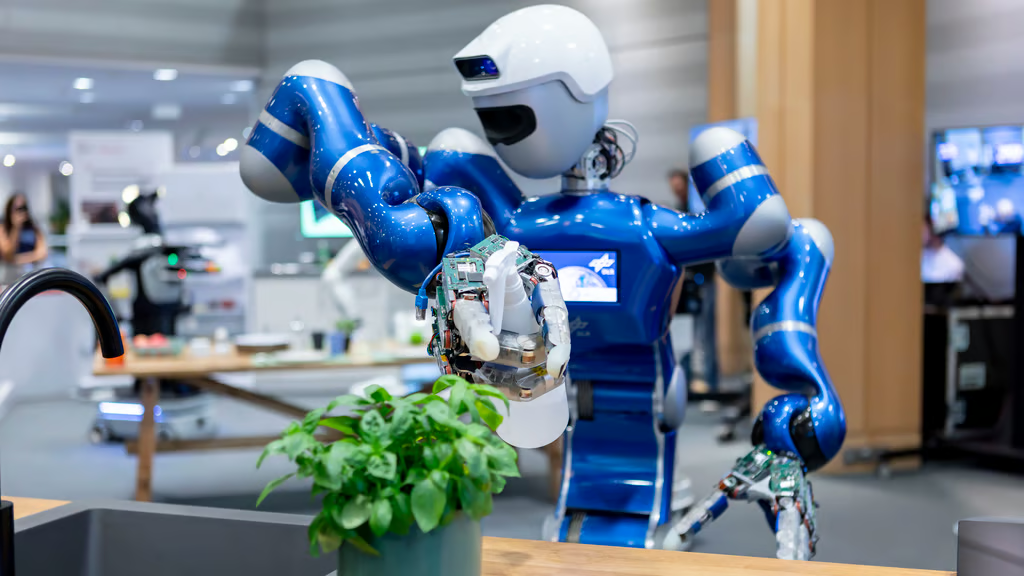
Fifteen AI-powered robots took over part of the European Parliament in Brussels on September 2, demonstrating tasks ranging from dismantling electronics to clearing a breakfast table and delivering parcels.
The showcase was organized by the EU-funded euROBIN robotics network and included humanoids, quadrupeds, drones, and industrial systems. Around 170 representatives from politics, industry, and research attended the demonstrations and a discussion about turning Europe’s robotics research into a larger commercial industry.
Four robots cleared a breakfast table together
One of the clearest examples of cooperation came from four household robots working on the same breakfast-table task.
According to the German Aerospace Center’s post-event report, the four systems operated autonomously while accounting for one another as they identified objects randomly placed on the table.
The robots picked up plates and a cereal box, then sorted items between a dishwasher, cupboard, fridge, and rubbish. DLR’s humanoid Rollin’ Justin was among the four systems.
Karlsruhe Institute of Technology also demonstrated its ARMAR-7 humanoid, which uses a cognitive architecture with episodic memory designed to store, retrieve, and share experiences.
The demonstration puts a practical spin on the growing physical AI push. Recent robot demos have increasingly moved beyond walking and balancing toward everyday manipulation, from autonomous ladder climbing to humanoids being tested in real-world service jobs.
The other demonstrations covered two additional euROBIN research areas. Five teams took part in a manufacturing scenario involving tasks such as refurbishing laptops, dismantling a robotic vacuum cleaner, mobile disassembly, advanced manipulation, and simulation.
A separate industrial robot cell developed by the Technical University of Munich, Jožef Stefan Institute, and University of Bremen demonstrated cable routing for wiring-harness assembly. For outdoor robotics, teams demonstrated autonomous parcel delivery using a centaur-style robot, a wheeled quadruped, and a drone equipped with an arm.
Cooperation is here, but portability is the harder test
The Brussels showcase provides a stronger example of multi-robot autonomy than the robot count alone suggests. Four different systems were not simply operating beside one another; DLR says they independently performed parts of the same household task while taking the other robots into account.
That distinction matters for organizations evaluating cooperative robotics. Coordinating several autonomous machines around shared objects and workspaces introduces problems that do not arise when one robot completes a task alone, including task allocation, collision avoidance, changing object locations, and recovery when another machine alters the environment.
The public material does not, however, establish that the four robots exchanged learned skills or operated through a common cross-platform control layer.
That gap is important because euROBIN’s broader scientific goal is to make robotic knowledge and skills transferable between different robots, tasks, and environments. A robot learning how to manipulate an object and another robot being able to reuse that capability would represent a substantially different step from several machines being programmed to cooperate in one prepared scenario.
The September 2 demonstration therefore documents cooperative autonomy, but it does not yet demonstrate universal robot interoperability.
For manufacturers and systems integrators, that separates something usable today from the more ambitious research target.
Multi-robot deployments can already divide work across specialized machines, but moving software, learned behavior, or task knowledge between robots from different developers still requires interfaces, safety validation, and integration work that the Brussels demonstration did not document publicly.
The final lineup of 15 also resolves an apparent discrepancy in earlier publicity. A European Commission event listing originally advertised 20 to 30 robots, while euROBIN’s later materials specified 15 and DLR confirmed that 15 systems ultimately demonstrated at the Parliament.
Organizers argued that AI-powered robotics could become a European industry comparable in scale to today’s automotive sector within 10 to 15 years. The Brussels demonstrations offered a glimpse of the technical pieces already working, while transferring skills between different machines remains a much bigger benchmark for euROBIN to meet.
Also read: Philips is using up to $33.7 million in ARPA-H funding to develop robotic technology for increasingly autonomous stroke procedures.