






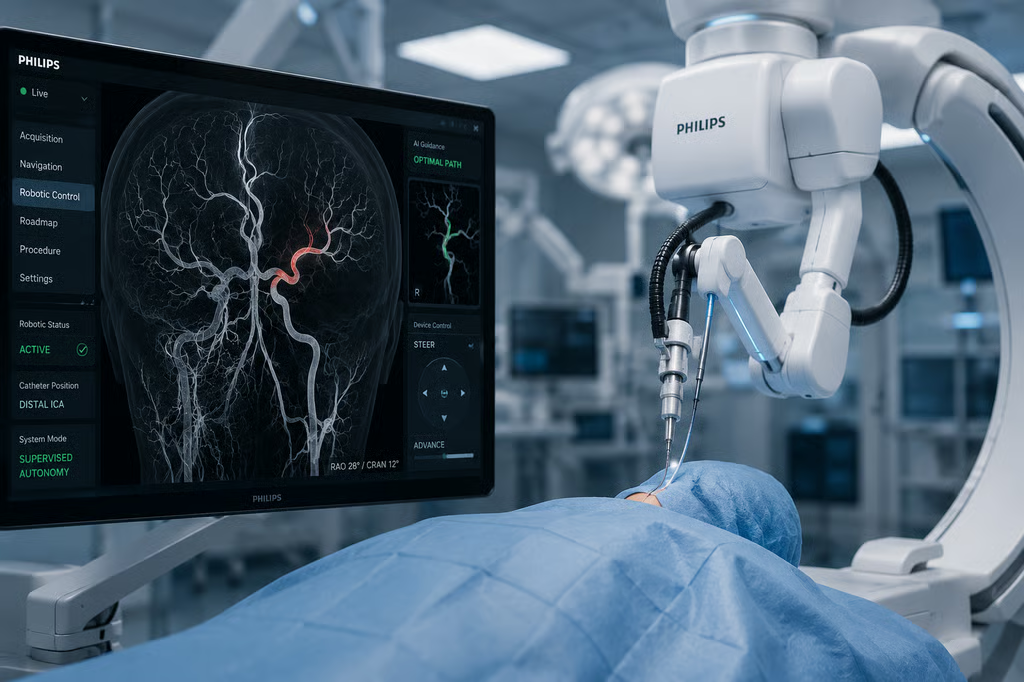


Philips has received up to $33.7 million from the Advanced Research Projects Agency for Health to develop AI-enabled robotic technology that could eventually perform increasingly autonomous stroke procedures.
The project targets a major treatment gap. ARPA-H says only about 12% of the 335,000 US stroke patients eligible for mechanical thrombectomy each year receive the procedure, while more than half of Americans live over an hour from a hospital capable of performing it.
Philips combines imaging, AI, and robotic catheters
According to Philips, the project will combine its existing image-guided therapy infrastructure with robotics, AI-enabled automation, and smart interventional devices.
The work covers endovascular navigation, robotic device control, image-based procedural guidance, workflow automation, and remote intervention. Philips says the system is being designed around increasing levels of supervised autonomy while keeping expert clinicians involved.
ARPA-H calls the Philips project A-RISE, short for Autonomous Robotics and Intelligent Imaging for Stroke Endovascular Care. It combines imitation-learning algorithms with a multi-channel, fluid-driven steerable catheter intended to navigate blood vessels and eventually perform mechanical thrombectomies and other neurointerventional procedures.
Johns Hopkins University will work on autonomous device navigation under mechanical engineering associate professor Axel Krieger. Boston University researchers Tommaso Ranzani and Sheila Russo are developing steerable catheter technology, while Dr. J Mocco of Weill Cornell Medicine is serving as a clinical collaborator.
The approach extends a broader shift toward connecting medical imaging directly with robotic movement. Recent robot-assisted pelvic fracture surgeries have used CT planning, navigation, and robotic positioning while surgeons remain in control.
Philips already has more than 20,000 image-guided therapy systems installed across more than 80 countries. The company is positioning A-RISE as an extension of that infrastructure rather than announcing a standalone commercial stroke robot.
Autonomous stroke treatment is still years from patients
Philips is one participant in ARPA-H’s broader Autonomous Interventions and Robotics program, which carries commitments of up to $175.3 million over five years.
Other teams are pursuing different routes to automated treatment. Stanford is developing a magnetic microbot that can navigate blood vessels and remove clots, while UC San Diego is building a soft “growing robot” designed to travel through the vasculature to the brain. UC Berkeley is separately developing a tiny crawling robot for procedures including brain-pressure relief.
ARPA-H has set aggressive milestones, but they remain preclinical. After 24 months, teams must demonstrate autonomous capabilities in benchtop or biological models. At 60 months, they are expected to demonstrate fully autonomous interventions in realistic models, animals, or human cadavers. The published program timeline does not include human trials.
That puts A-RISE beyond a simple robotics concept but well short of clinical deployment. Other systems have already demonstrated narrower robotic capabilities, including a brain-imaging robot that shortened procedure time and humanoid robots completing preclinical surgical tasks, but neither represents autonomous thrombectomy in patients.
Philips now has to prove that imaging, AI navigation, catheter control, and remote supervision can work as one reliable system. The first meaningful checkpoint is ARPA-H’s 24-month demonstration, where the project will have to move from a funded architecture to autonomous performance in a controlled model.
Also read: Robotic heart surgery using the da Vinci 5 is already moving complex procedures toward smaller incisions while keeping surgeons in direct control.