







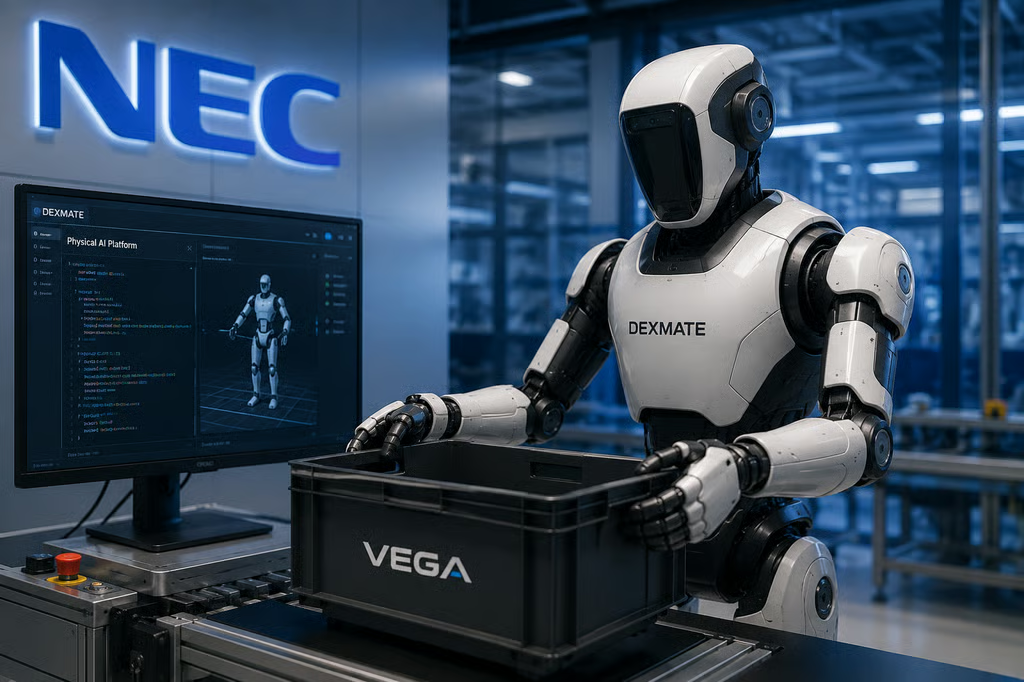
Japanese technology company NEC is backing US robotics startup Dexmate, which pairs its VEGA humanoid robot with software designed to make AI-powered robots easier to develop, configure, and operate.
The investment comes through the NEC Orchestrating Future Fund, NEC’s corporate venture capital fund. The companies did not disclose the investment amount or announce a specific pilot, customer deployment, or product launch tied to the deal.
NEC backs Dexmate’s robot development platform
According to NEC, Dexmate was founded in 2024 by AI robotics researchers and offers VEGA alongside a Physical AI development platform. NEC says the combined system is intended to simplify the process from robot development through deployment.
Building robots for real-world work typically involves sensors, control systems, training data, simulation environments, and on-site tuning. Dexmate is trying to bring more of those steps into one development environment rather than treating the humanoid itself as the entire product.
That software layer is increasingly important as physical AI moves from research labs into factories, logistics sites, and other real-world environments. Hardware determines what a robot can physically do, but software determines how easily those abilities can be adapted to new tasks and workplaces.
Dexmate CEO Tao Chen said the company expects NEC’s global expertise to help deploy its technology across industries. NEC Corporate Senior Vice President Shigeki Wada was more measured, saying the two companies will explore opportunities to create value and advance real-world uses for Physical AI.
Another Japanese manufacturer is already taking a more direct route into humanoid robotics. Mitsubishi Motors has invested in University of Tokyo startup Highlanders and plans to test its humanoids inside Mitsubishi factories while exploring production at its Kyoto plant as early as 2027.
Those investments reflect growing interest in moving humanoid robots beyond demonstrations and into workplaces where they have to perform repeatable tasks alongside existing equipment and people.
Software could lower one barrier to humanoid deployment
Dexmate’s focus on the development platform addresses a practical problem for robotics: even capable hardware can be difficult to configure for each new task, facility, or workflow.
A platform that reduces programming and setup work could make robots easier to redeploy as jobs change. That could become increasingly valuable if humanoids are expected to move between tasks rather than remain dedicated to a single tightly scripted process.
Software cannot solve every constraint. McKinsey identifies mobility, dexterity, safety, battery life, and cost among the major barriers to wider humanoid adoption. Most humanoids can operate untethered for only two to four hours per charge, while actuators can account for 40% to 60% of hardware costs.
The industry is therefore developing on two tracks. Robot makers are improving bodies, batteries, hands, and actuators, while companies building simulation, AI models, and development tools are trying to make those machines easier to train and deploy. Recent humanoid development has already put particular pressure on software limitations as robots move into less predictable environments.
NEC’s investment places it on the software-and-deployment side of that equation without committing the company to manufacturing VEGA itself. The next development to watch is whether the relationship produces a real deployment or deeper technical collaboration, giving Dexmate a chance to demonstrate how much its platform can shorten the path from programming a robot to putting one to work.
Also read: China’s World Robot Conference put humanoids through factory-style tasks as robot makers faced pressure to turn increasingly capable prototypes into commercially useful machines.