







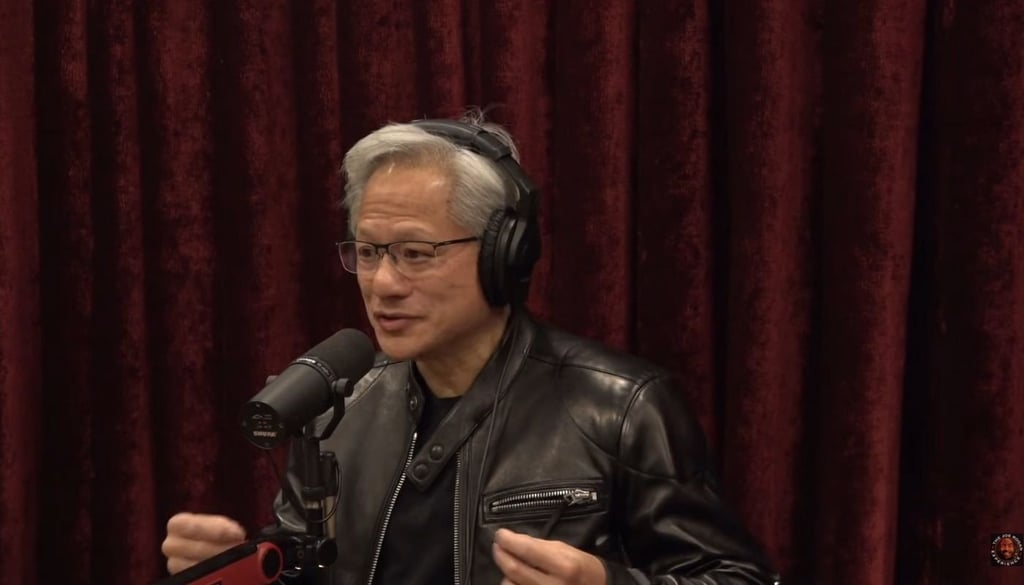
AI isn’t racing toward catastrophe; it’s getting safer as it gets stronger. That was the message from Nvidia CEO Jensen Huang, who argued that today’s leaps in AI are reinforcing safety, not eroding it.
On The Joe Rogan Experience, Huang pushed back on popular doomsday scenarios, saying an AI takeover is “extremely unlikely” and that new computational power is being directed into accuracy, grounding, and control. His comments set up a stark contrast with prevailing fears, suggesting a more measured future for the technology without giving away where he thinks the limits lie.
Where AI’s new power is going
Huang said the newest wave of AI horsepower isn’t being used to make models wilder, it’s being used to make them steadier. He told Rogan that recent systems have become “100 times more capable” but that the extra capacity is being pushed into reasoning and self-correction rather than raw output.
According to him, today’s models “break problems down,” “ask themselves if they’re certain,” and go back to “do more research” when they’re not. He described this as a deliberate shift toward systems that can “ground it on truth,” crediting cutting down on hallucinations and tightening overall reliability.
Not a galaxy ahead
The CEO said the popular image of an AI suddenly vaulting past human control doesn’t match how the technology evolves. Progress, he told Rogan, moves “a click ahead, not a galaxy ahead,” and every major player is pushing forward at roughly the same pace, leaving little room for one system to break away and dominate.
He compared the landscape to cybersecurity, where defenders track attacks in real time and share fixes before threats can spread. In his view, advanced AIs would follow a similar pattern, with powerful systems checking one another, spotting surprises early, and keeping outliers from running unchecked.
The next chapter of work in the AI era
AI’s rise, according to Huang, isn’t a story of disappearing jobs but rather a change in what those jobs involve.
He told Rogan that automation often enlarges a field rather than hollowing it out. Radiology was his clearest example: machines now handle an enormous volume of image review, yet hospitals have brought on more specialists because the overall demand for their expertise has grown. As AI tools take on repetitive tasks, the work that remains relies more on judgment and situational calls that machines can’t handle.
He also described AI as a tool that could widen the doorway into many careers once gated by technical know-how. Modern systems can be operated in plain language and walk users through unfamiliar steps, reducing the training needed to get started.
One factor AI can’t outrun
Rogan pressed Huang on what might slow the industry’s rapid climb, and the answer wasn’t model design or research breakthroughs. It was electricity. Huang said power is the real throttle on AI’s future, noting that each new generation of systems demands far more energy than the last. Keeping pace, he added, will require fresh infrastructure, including the small nuclear reactors and alternative sources now being discussed inside the sector.
He said energy availability is the variable that will decide how far and how fast AI can advance. Without a dramatic expansion in supply, even the most ambitious models will hit a ceiling long before hitting their technical limits.
Destination undefined
When Rogan asked where all of this ultimately leads, Huang didn’t pretend to have a neat answer. “I’m not sure,” he replied, adding that “I don’t think anybody really knows” what the far-off picture looks like. Instead of sketching a grand theory, he kept his focus on what can be built, tested, and fixed in front of him.
He defined his role as tackling the next set of engineering challenges, such as continually making systems safer, faster, and more cost-effective with each iteration. He suggested that subsequent generations would then determine the applications and purpose of the tools they inherited.
The destination may be undefined, but his stance was matter-of-fact: keep improving the technology, tackle issues as they surface, and resist the panic that comes from pretending anyone has the final word on where AI ends up.
Nvidia’s new $2 billion Synopsys tie-up hints at how aggressively the company is moving to shape the next era of chip design.