






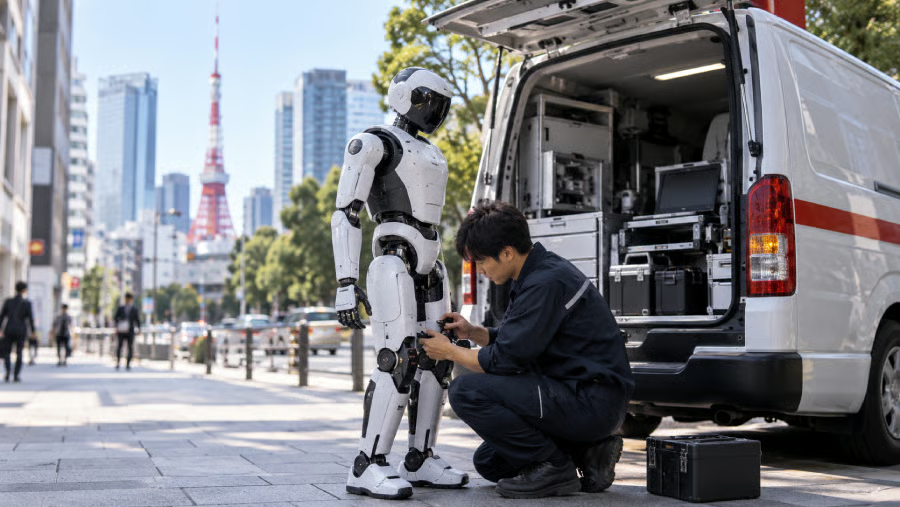


If a humanoid breaks down in Tokyo, GMO wants businesses to have something close to a 911 call for robots.
Japanese technology company GMO AI & Robotics plans to deploy a mobile repair unit for humanoid robots in Tokyo later this month. The vehicle carries engineers, tools, spare parts, and a replacement humanoid to customers, giving businesses a way to get a failed robot back into service without waiting for it to return from a repair center.
GMO takes the repair shop to the robot
The GMO Humanoid Ambulance is designed to respond when one of the company’s humanoids breaks down or malfunctions. An engineer can attempt repairs on-site. If the robot needs more extensive work, a replacement can take over while the damaged unit returns to a repair facility.
GMO AI & Robotics President Tomohiro Uchida said the company wants to support the “social implementation and operation of humanoids.” GMO developed the service after previous repairs forced robots out of service and disrupted customers, according to Kyodo News.
Euronews said that only one vehicle is currently based at GMO’s Tokyo headquarters, although the company may add vehicles and service bases if demand grows.
Japan’s humanoids are moving into everyday workplaces
Japan already has humanoid trials in settings where a breakdown could interrupt normal operations.
Kyodo News noted that GMO Internet Group and Japan Airlines began testing humanoids at Tokyo’s Haneda Airport in May to transport passenger luggage. KDDI and Osaka Metro followed with an August trial using a humanoid for customer service at railway stations.
Japan also plans to introduce around 10 million robots across 18 sectors by 2040, including manufacturing, healthcare, and food services.
The deployments bring a practical question into focus: Who keeps these machines working once businesses start relying on them?
What eWEEK found: APAC’s humanoid race is becoming a support race
Humanoid development across APAC is moving at different speeds and solving different problems.
Market | 2026 activity | Main focus |
Japan | Airport, railway, and mobile repair trials | Keeping deployed robots working |
China | Factory production-line trials | Repeated industrial tasks at scale |
Singapore | Shared robotics testbed | Deployment infrastructure and safety |
Japan is testing support alongside deployment
GMO has acknowledged that its airport humanoids cannot yet fully replace ground-handling workers. One limitation is payload capacity, with the Unitree G1 development platform able to lift only around 3 kilograms with its arms.
The company is also pairing repairs with field-data collection, software improvements, and network monitoring for unauthorized access. For customers, that puts hardware maintenance, software performance, and security under the same operational umbrella.
China and Singapore are tackling different challenges
In China, AGIBOT said its humanoids completed more than 64 hours and 64,828 tasks during a June 2026 trial on an active tablet production line. The robots worked inside a live mass-production quality-inspection process, testing whether humanoids could handle repeated tasks alongside existing manufacturing operations.
Singapore, meanwhile, is developing a shared robotics testbed at Punggol Digital District for uses including delivery, cleaning, and security. According to IMDA, the program will allow multiple operators to test robots in a public environment while addressing infrastructure integration, regulation, and safety requirements.
For APAC businesses, robot specifications tell only part of the story. Repair time, replacement units, local support, cybersecurity, spare parts, and integration with existing operations will also determine whether humanoids can become dependable workplace equipment.
Support may decide which humanoids scale
Japan’s robot ambulance shows what humanoid adoption starts to look like once the machines move from demonstrations into daily operations. Businesses will need to consider not only whether a robot can perform a job, but also how quickly it can be repaired, replaced, and returned to service when something goes wrong.
Interesting Engineering highlighted that GMO’s model is built around reducing that downtime by bringing engineers, repair equipment, replacement parts, and a spare humanoid directly to the customer. If repairs cannot be completed on-site, the damaged unit can be taken back while the replacement keeps the service running.
As more humanoids enter airports, stations, factories, and other workplaces across APAC, the competitive advantage may increasingly extend beyond the robot itself. Repair networks, spare parts, cybersecurity, replacement units, and response times could become just as important as the capabilities that get humanoids deployed in the first place.
See how the global humanoid race played out in Beijing, where 2,056 robots from 16 countries competed in the World Robot Games.