







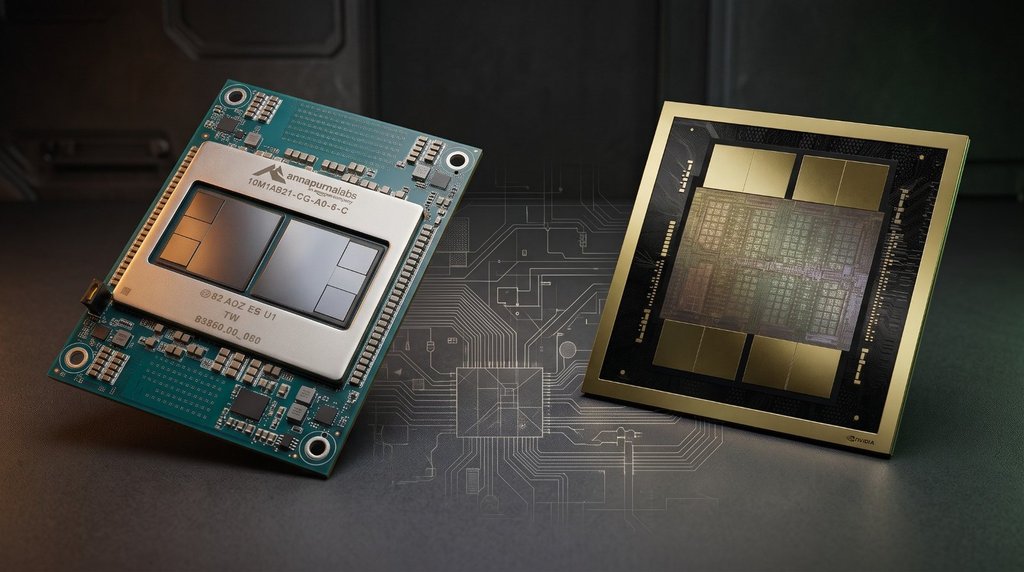
Amazon's latest move against Nvidia isn't a new chip. It's a deal for software that could help its existing chips do more work.
On Nov. 23, Amazon announced an agreement to acquire AI optimization technology from Israeli startup Decart and bring its founders, researchers and engineers on board. Bloomberg reported a deal value of approximately $7.5 billion, though Amazon has not confirmed the figure.
Amazon CEO Andy Jassy outlined plans in October to offer Trainium outside Amazon Web Services (AWS) in late 2027. Attracting customers already using Nvidia GPUs will mean making the switch worthwhile, even after accounting for the cost of adapting their applications.
How Decart could make Trainium more competitive
Amazon's agreement covers the technology behind the Decart Optimization Stack (DOS), rather than the entire startup. The companies have collaborated on Trainium since 2025.
Nvidia participated in Decart's $300 million funding round in May 2026. Reuters reported that the startup's most recent valuation was nearly $4 billion. Decart's legal adviser, Paul Hastings, confirmed on Nov. 25 that the transaction remains subject to regulatory clearance and other closing conditions.
DOS is designed to improve how AI workloads use computing resources across Amazon, Nvidia and Google chips. Nvidia's CUDA software platform provides libraries, compilers and development tools that developers have built applications around for years.
An enterprise can rent a different AI accelerator in the cloud. Getting its existing software to run efficiently on that hardware can be a much bigger job.
Nvidia continues to expand its ecosystem with products such as its four-system DGX Spark developer kit. Amazon, meanwhile, released TorchNeuron in public beta on Oct. 20, providing native PyTorch support on EC2 instances equipped with Trainium2 or Trainium3 chips.
In an account of early video generation tests published by AWS, Decart reported up to four times the frame throughput and twice the cost efficiency of high-end GPUs. Reported latency fell from 40 milliseconds to 10 milliseconds.
Those are promising figures for video generation, but not a buying guide for every AI workload. The customer testimonial does not identify the comparison GPU model or detail its testing methodology. As Apple's distributed inference tests also illustrate, performance gains depend on the workload.
Trainium already supports large-scale AI deployments. In April 2026, Anthropic reported using more than 1 million Trainium2 chips to train and run Claude.
What eWeek Found: PyTorch compatibility doesn’t eliminate migration work
AWS introduced TorchNeuron to help developers use familiar PyTorch code on Trainium. Its technical documentation, however, identifies hardware-specific adjustments that some applications still require.
Developers compiling models may need to remove CUDA-specific settings and select a different compilation backend. Those distributing models across multiple processors may also need to adjust how workloads are divided among Trainium's NeuronCores.
Getting a customer-service AI model to run on Trainium is one thing. To determine whether moving it off Nvidia hardware makes financial sense, compare the cost of handling the same volume of requests without sacrificing speed or accuracy, factoring in migration expenses. Similar trade-offs arise when evaluating AI model reasoning costs against output quality.
Amazon's acquisition announcement does not specify whether DOS will continue supporting competing chips if the deal closes. Amazon may make switching away from Nvidia easier, but enterprises still need to know how much the move saves, how much engineering work it takes and whether they will be free to switch again.
Thinking about putting AI agents to work on your team? Explore AI courses from The Neuron Academy to build the skills to evaluate where agents can help and where you still need a human in the loop.