







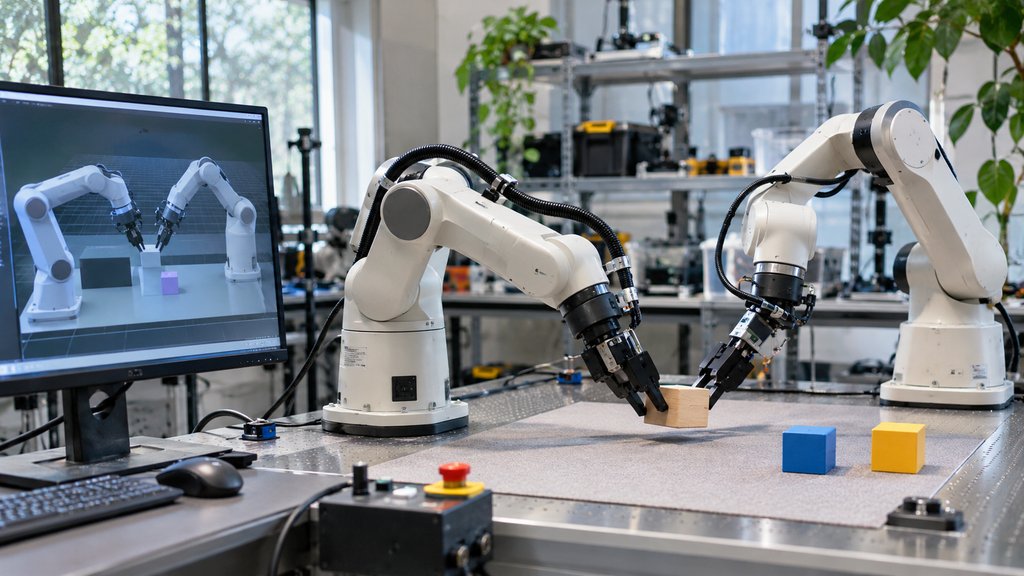
A robot arm can rehearse picking up an object thousands of times without risking a real-world spill. Getting two arms to work together is proving a much tougher challenge.
Singapore-based Einsia AI has released RoboUniverse-10K, a collection of 10,807 interactive robot-training simulations created from real-world videos. Announced Nov. 25, the project lets researchers train AI systems on physical tasks without relying entirely on expensive robot hardware.
After fine-tuning one AI model using the simulations, Einsia reported that its success rate jumped from 0.8% to 21.2% on the company's own 500-task benchmark. The gains were much stronger for single-arm tasks, while coordinating two arms remained difficult.
How RoboUniverse-10K trains robots using real-world videos
According to Einsia's announcement, RoboUniverse-10K uses Nvidia Isaac Sim to recreate robot-manipulation tasks from real-world footage.
AI agents reconstruct scenes, write control programs, and create automated checks to determine whether a task succeeds.
The resulting environments let robots practice movements repeatedly in simulation, from lifting objects to coordinating two arms during more complicated tasks.
The collection includes:
- 4,132 single-arm tasks using Franka robots.
- 6,675 dual-arm tasks using AgileX robots.
- 10,307 training environments and 500 evaluation tasks.
Researchers fine-tuned Qwen3.6-35B-A3B using approximately 17,000 interaction trajectories generated with GPT-6 Astra. The experiment used supervised fine-tuning rather than reinforcement learning to improve the model.
On Einsia's RoboUniverse-Verified benchmark, the results were:
- Overall success: 0.8% to 21.2%.
- Single-arm success: 2.0% to 40.5%.
- Dual-arm success: 0% to 8.3%.
- Single-arm pick-and-place: 0% to 62.2%.
A robot picking up an object with one arm has fewer movements to coordinate than a machine using two arms to position, stabilize, and manipulate the same object.
That challenge is familiar in dual-arm factory robots, where coordinated movements can determine whether a task succeeds.
Einsia also demonstrated its trained model on a physical Franka robot. The machine drew the company's logo on a whiteboard using visual feedback and repeated corrections.
However, Einsia didn't provide a success rate across repeated real-world trials.
What eWeek found
The results suggest that large collections of simulated tasks can improve robot-control capabilities. But the headline figure comes with an important qualification.
Einsia developed the 500-task benchmark itself, and its dataset documentation describes limitations in how the evaluation set was selected.
Researchers replaced 68 tasks from an earlier selection using previously observed successful cases. The documentation also cautions that the benchmark wasn't a blind random sample and doesn't guarantee separation between training and testing data.
The company has released its simulation environments, trained model, and evaluation code, allowing independent researchers to test its findings.
For robotics developers, a useful evaluation would involve:
- Repeating the results using the released benchmark.
- Testing unfamiliar tasks outside the original evaluation.
- Comparing single-arm and dual-arm performance separately.
- Measuring success across repeated physical-robot trials.
Running the system also requires substantial computing resources, including Nvidia RTX-capable simulation hardware and enough GPU memory to serve the model.
RoboUniverse-10K joins efforts to automate robot development and research into faster robot training.
Einsia has demonstrated meaningful gains in simulated robot tasks. Whether those improvements hold up when physical robots face unfamiliar objects, changing conditions, and repeated operations remains to be tested.
Also read: Runway's Praxis-1 robotics model is now available for commercial use, offering developers another approach to training robots for physical tasks.