








A humanoid can only act on what it can reliably see. A machine-vision company wants to help it see better.
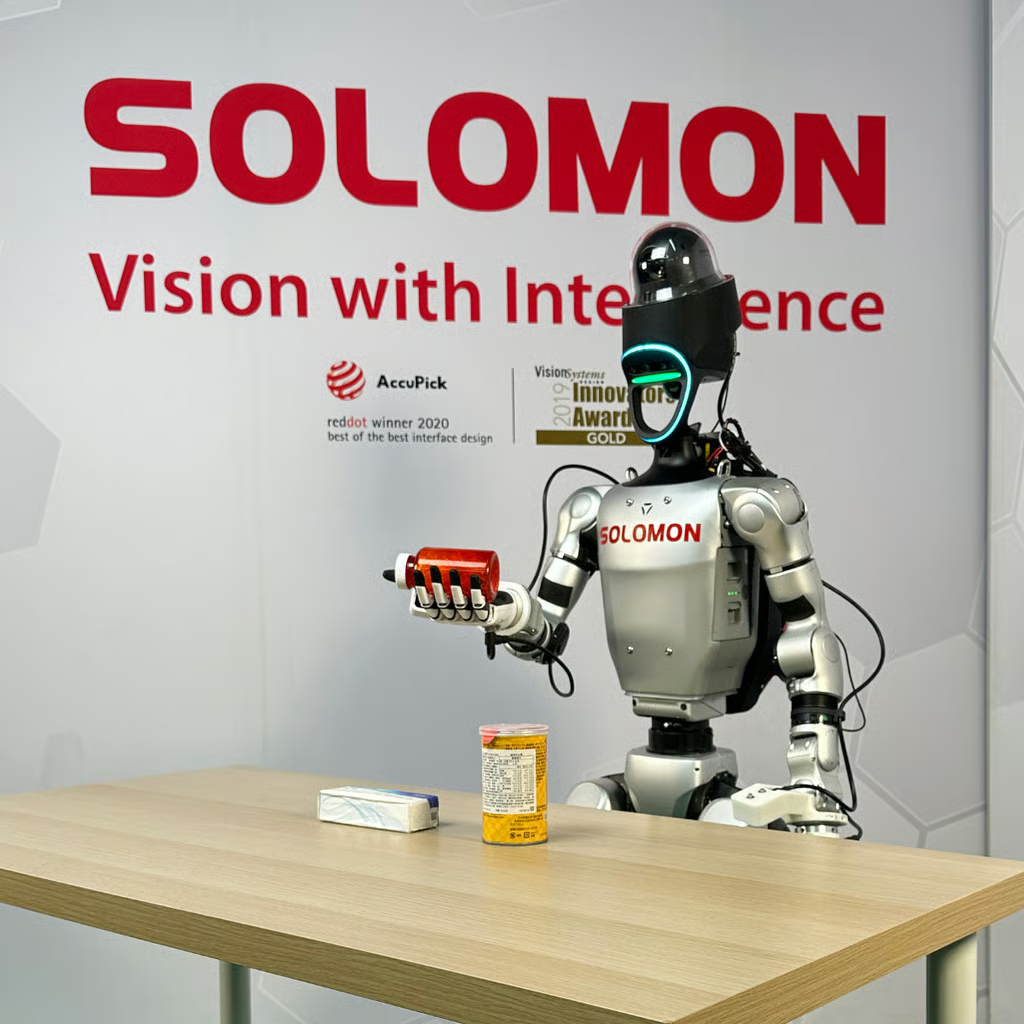
Taiwan-based Solomon demonstrated AI vision software on a humanoid that could take spoken or written instructions and complete tasks without having each step pre-programmed, according to CNA.
Better perception could help robots recognize what is around them and adapt when the scene changes.
Active perception gives the robot another look
According to CNA, Solomon’s Active Perception technology lets a robot check its surroundings more than once. Instead of relying on one look, the software can focus on a target and check again as the robot moves.
Chairman Johnny Chen said many robot vision modules struggle to identify objects reliably beyond roughly two meters. In the demo, Solomon’s system found a target about five meters away before the humanoid walked toward it.
Developers working on safer humanoid robots face a similar challenge: machines need enough visual information before they move. After an object was moved, the humanoid found it again instead of returning to the old location.
A software bet on robot vision
Solomon’s core business centers on AI-powered 3D vision and machine-vision software, with its technology applied across different robot platforms.
Its vision technology is already used beyond humanoids. The company has deployed it on drones and autonomous mobile robots, as well as robotic arms and four-legged inspection robots in the US and Japan. Several of those systems are used for inspection and maintenance. At solar farms in southern Taiwan, drones use the software to spot obstructions on panels and send images back to maintenance crews.
Humanoids give Solomon another place to apply the same kind of technology.
Better vision still has to survive the factory floor
Manufacturers and warehouse operators will want to know how often workers still need to step in once a robot is on the floor. Shelves get rearranged. Workers block cameras. Inventory ends up somewhere unexpected.
Teams evaluating factory-floor humanoids should look closely at recovery. A robot that loses sight of an object or finds it somewhere new needs to keep working without someone resetting the task. Repeated recovery across a shift will tell operators more than one clean pickup in a demo.
Warehouse teams face the same issue with warehouse robot systems. If better vision helps machines recover when inventory moves, operators could spend less time restarting stalled tasks.
Vendor demos can impress. Buyers still need to know whether the robot can recover on its own.
Also read: Atlas needed millions of hours of simulation before completing a task that looks simple for a person: moving a mini-fridge.