







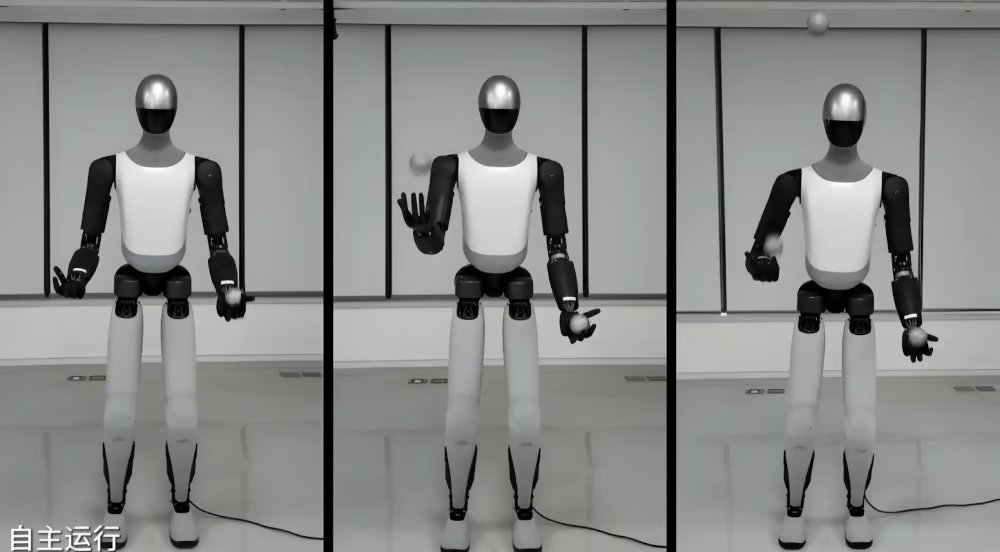
After four months of punching the clock on an auto assembly line, Xiaomi's latest humanoid robot is moving beyond the usual stage-demo routine.
Xiaomi unveiled the new-generation robot on Wednesday at the 2026 World Robot Conference in Beijing after roughly four months of training in its electric vehicle factory, where it has been tested on repetitive production tasks, including nut installation, panel sorting, and box folding.
The design is deliberately industrial, with a light-gray body and matte-silver helmet-style head. At the conference, Xiaomi showed the robot working as a florist. It picked up bouquets, added scented sheets, and handed them to visitors before performing handshakes, fist bumps, and heart gestures. Xiaomi said the movements were controlled by an embodied large model rather than preset scripts, according to 36Kr.
The bigger experiment is whether those months on the factory floor can turn a humanoid prototype into something manufacturers can actually depend on. Xiaomi's latest performance numbers suggest progress, but they also show how far humanoid robots still have to go before they can work alongside conventional industrial machinery at scale.
The factory is the real test
The more important demonstration happened before the robot reached the exhibition hall.
Xiaomi trained it on production tasks, including self-tapping nut installation, flexible center console panel sorting, and material box folding. At one workstation, the robot operated independently for three hours while maintaining a 76-second production cycle and a 90.2% installation success rate, according to Xiaomi data cited by TechRepublic.
By July, success on bilateral nut installation had climbed to 98%, while panel sorting and material-box folding each reached 90%. That progress highlights a problem that is easy to overlook in flashy humanoid demonstrations: industrial robots cannot simply perform a task once. They have to do it repeatedly, at production speed, without disrupting the line.
Lei Jun, Xiaomi’s founder, described the difference between laboratory and factory conditions as a major challenge, noting that laboratories can tolerate thousands of failures during experimentation while factories require consistent success.
The robot is part of Xiaomi’s broader push into embodied AI rather than a standalone hardware business. The company is combining its humanoid platform with multimodal perception, reinforcement learning and models such as Xiaomi-Robotics-0.
Xiaomi has also developed Xiaomi-Robotics-1 and launched the 38-billion-parameter Xiaomi-Robotics-U0 world model, according to 36Kr. The company’s financial commitment is growing, too. Xiaomi spent 9.23 billion yuan on R&D in the second quarter, up 18.9% from a year earlier, with smart EVs and AI among the main areas of investment.
The commercial catch
For now, however, this is still a research project, not a new Xiaomi product line. The robotics business has no independent external revenue and remains focused on prototypes and internal validation, according to 36Kr. Xiaomi executive Lu Weibing has also said humanoid robots remain some distance from mass commercialization.
That makes the factory trials more significant than the conference performance. A robot that can reliably handle repetitive manufacturing work could eventually help Xiaomi reduce factory costs while generating valuable data for its AI systems.
But the 98% figure also reveals the remaining gap: a production line cannot afford a robot that occasionally gets the job wrong. Xiaomi’s next challenge is therefore less about making Tieda look human and more about making it dependable enough to work like a machine.
Why this matters beyond Xiaomi
For manufacturers, Xiaomi’s experiment offers an early look at where humanoid robots may first deliver practical value. Factory work gives companies something conference demos cannot: measurable data on cycle times, failure rates, consistency, and how often humans still need to step in.
That matters because the business case for humanoid robots will depend less on how human they look and more on whether they can reliably take over repetitive or physically awkward tasks without slowing production. If Xiaomi can push those success rates closer to industrial standards, other manufacturers may have a clearer benchmark for deciding when humanoid robotics is ready for real deployment rather than another pilot.
For technology leaders, the bigger signal is that embodied AI is moving from model development to operational testing. The companies that learn to integrate AI models, robotics hardware, and real-world production data could shape how quickly humanoids move from experimental systems to becoming another piece of enterprise automation.
Related reading: For another look at how humanoid robots are being pushed beyond basic movement, see how Figure 03 climbed a ladder autonomously in a recent real-world mobility demo.