Blast off, Tech Insiders. A $2 trillion rocket ride meets a government-grade shutdown, proving space isn't the only place with hard vacuum.
Strap in: gravity's optional, but regulatory red lights are not. |
|
|
|
Here's what you need to know today: |
|
|
|
US Export Ban Forces Anthropic to Disable Fable 5 and Mythos 5 Worldwide |
When Uncle Sam slams the door, even chatbots go silent.
The Commerce Department's 5:21 p.m. ET directive on Friday ordered Anthropic to bar any foreign national, even those on US soil, from its new Fable 5 and Mythos 5 models, which had just launched on Tuesday. Unable to segregate users fast enough, the company yanked both models for everyone worldwide, including its own foreign-born engineers.
Officials say a corporate partner—Amazon, following a tip from CEO Andy Jassy to the White House—showed how to "jailbreak" Fable's cybersecurity guardrails, calling the freeze a national-security precaution.
Anthropic insists the exploit is narrow, functioning more like standard "defense-oriented prompting," and no more potent than what public models already allow. It argues that taking down a commercial system used by millions is a drastic overreaction. |
Image created with ChatGPT |
The unprecedented move shifts US export controls from chips to the AI models themselves. It deepens Anthropic's clash with Washington (it's already been slapped with a Pentagon "supply-chain risk" label) and chills investor excitement ahead of a rumored fall IPO. Abroad, officials cite the episode as proof that nations need "AI sovereignty" rather than dependence on US labs.
Why it matters: If Washington can shutter a frontier model overnight over a partner's basic cyberprompting, it sets a precedent for treating advanced AI like munitions, reshaping how, where, and for whom the next generation of intelligence is built. |
|
|
|
Should Washington be able to pull an AI model worldwide over a potential jailbreak? |
|
|
|
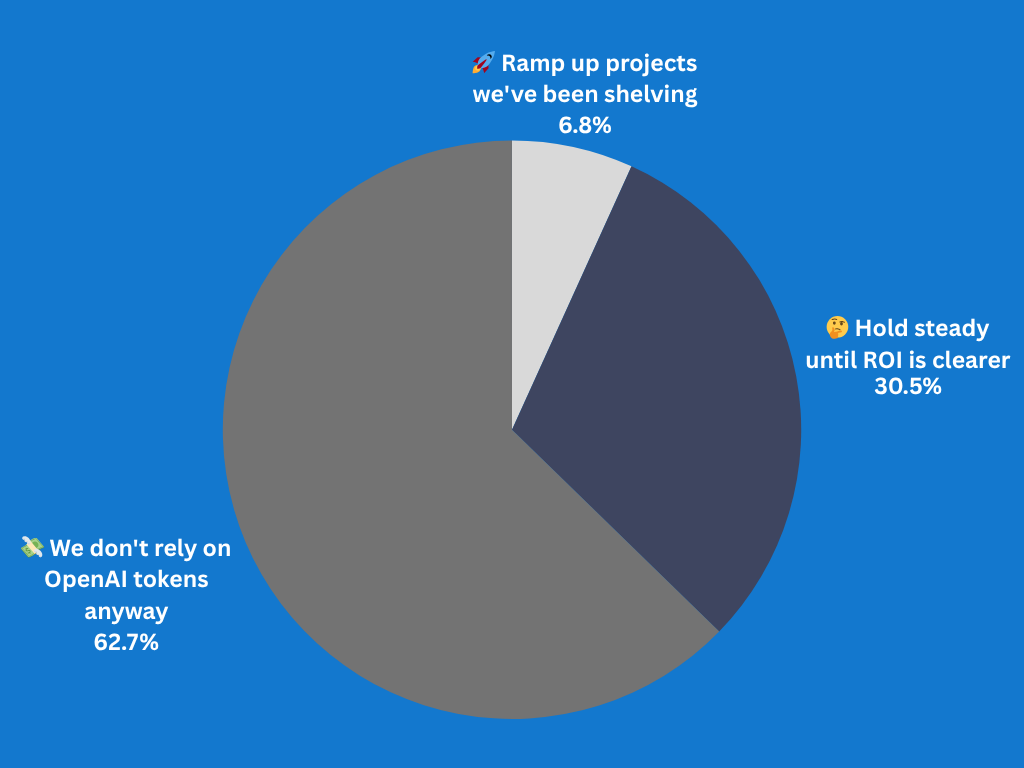
Results from Friday's Pulse Check |
If OpenAI slashes token prices, how will your team respond? |
|
|
|
OpenAI Buys Ona for Secure Codex Agents |
On June 11, OpenAI announced plans to acquire German startup Ona, folding its secure cloud sandboxes into Codex so enterprises can run long-lived coding agents in their own clouds.
Ona, formerly Gitpod, builds fenced workspaces where AI agents can compile, test, and commit code without touching production systems until humans approve the diff. The model suits banks, pharma giants, and government shops that like Codex's speed but worry about keys, audit trails, and rogue prompts. |
More than 5 million people now use Codex each week, up 400% since the start of the year. With one in five of those users now being nontechnical knowledge workers, OpenAI says customer-controlled environments are the next hurdle as workflows stretch from minutes into multiday jobs.
The buyout lands just days after OpenAI confidentially filed for its IPO, and just as rival Anthropic courts the same Fortune 500 developers with Claude Code. By grabbing the execution layer instead of tweaking parameters again, OpenAI is betting trust sells better than token counts.
In short, Codex gets guardrails, Ona's team joins OpenAI (pending regulatory nods), and dev laptops might finally get a day off. | |
|
|
Every company needs an AI brain. Get yours in minutes, not months. Adapt connects to your company's tools and becomes the brain that answers questions, automates the busywork, and builds internal apps – all from Slack. |
- Connect Slack, HubSpot, Stripe, your DB, and 100+ tools
-
Ask in plain English, get evidence-backed answers
- Automate reports and workflows on a schedule
- Use the best intelligence, including Claude Fable 5
|
For a limited time, Adapt is offering a 60-day pilot program to qualified companies and $100 in credits to every new user who signs up with their work email. |
|
|
|
New 'GreatXML' BitLocker Bypass Raises Questions |
Security researcher Nightmare Eclipse released GreatXML, an unpatched zero-day proof of concept that plants an unattend.xml and tweaks Recovery files on Windows' hidden partition, then reboots into Windows Recovery to open a shell with full access to a BitLocker-encrypted drive.
Tests so far show the trick is hardly a drive-by hack: attackers still need local administrator rights to write to the recovery partition, and the host must have run Defender Offline Scan at least once.
Researcher Will Dormann says the exploit only fires after the next offline scan is triggered, making it slower and less practical than simply turning BitLocker off once you already have admin access.
Because there is no official patch or CVE for GreatXML yet (do not confuse this with June's patched CVE-2026-50507 "YellowKey" BitLocker bypass), admins should audit machines that routinely run Defender Offline Scan, and set up alerts for unexpected writes of unattend.xml or new Recovery folders on the recovery partition—a telltale sign of tampering.
|
CISA's 72-Hour Patch Mandate |
The Cybersecurity and Infrastructure Security Agency just slashed federal patch deadlines: its new Binding Operational Directive 26-04 gives civilian federal agencies 72 hours to fix the highest-risk internet-exposed flaws, replacing the 15-day window set in 2021.
AI–powered exploit kits helped force the change. Experts warn models like Anthropic's Mythos are shrinking the gap between disclosure and mass exploitation. The directive's four-point rubric (exposure, KEV listing, automation potential, and post-exploitation control) now dictates patch timelines, sliding from three days for the most severe threats to up to 60 days for lower-risk ones.
The stopwatch is already ticking: agencies had to patch an actively exploited Ivanti Sentry flaw by yesterday and an Oracle PeopleSoft remote-code flaw by today, both newly added to the Known Exploited Vulnerabilities catalog. To protect against the Oracle bug, immediately disable the Environment Management Hub or block perimeter access to /PSEMHUB/*. For the Ivanti flaw, if you haven't patched yet, assume you are already compromised.
Security teams should audit the KEV list now, tighten asset tagging, and rehearse forensic triage before the next exploit drops. Patch quick or patch later—but since CISA strictly counts calendar days, a Friday exploit means "later" is now Monday. |
SpaceX Shatters Records With $2 Trillion Debut, Igniting Wall Street’s AI IPO Era
|
Wall Street is waking up to a new $2 trillion reality this Monday morning. SpaceX's blockbuster IPO debuted on Friday with shares jumping 19% on day one, officially sending the valuation past 2 terabucks and crowning Musk the world's first trillionaire.
Investors are treating SpaceX less like a launch contractor and more like a Starlink-powered telecom, AI infrastructure play, and defense giant rolled into one, causing so much retail frenzy that it gave Robinhood a brief panic attack. |
The initial stock-market splash had landed like a meteor: the company raised $75 billion at $135 a share, instantly valuing Elon Musk's rocket-to-everything empire at an eye-watering $1.77 trillion—before regular trading even began. But as the dust settles this Monday morning, the real industry shakeup begins. Nasdaq and FTSE Russell quietly rewrote their rulebooks to fast-track SpaceX into flagship indexes, meaning the stock will seep into millions of 401(k)s within days, whether mom-and-pop savers want the volatility or not.
Critics note the company lost nearly $5 billion last year, leans heavily on unproven orbital AI data centers, and still needs Starship to work, but for now, gravity is no match for market FOMO.
Wall Street, we have liftoff. Now, as index funds are forced to buy in and rivals OpenAI and Anthropic prep their own mega-IPOs, let's try sticking the landing. |
|
|
|
|
Writer/Editor at TechnologyAdvice |
Justin Meyers is an investigative writer and editor who draws on over a decade of meticulous hands-on research to deliver the full, trustworthy story behind consumer and enterprise tech, including cybersecurity. |
|
|
|
Curious about where AI is really headed? |
The Neuron cuts through the noise to bring you smart, hype-free takes on the latest AI trends, tools, and breakthroughs. Join 700,000+ professionals from top companies like Microsoft, Apple, Salesforce, and more.
|
|
|
|
Advertise in Daily Tech Insider! Daily Tech Insider is a TechnologyAdvice business. © 2026 TechnologyAdvice, LLC. All rights reserved.
TechnologyAdvice, 3343 Perimeter Hill Dr., Suite 215, Nashville, TN 37211, USA. |
|
|
|
|