The future is arriving with a price tag, Tech Insiders.
Snap's new AR glasses cost more than some laptops, Nvidia just locked in a massive $25 billion debt raise, and GitHub's AI coding boom is creating unexpected infrastructure headaches. Let's trace where today's AI dollars are flowing. |
|
|
|
Here's what you need to know today: |
|
|
|
Snap's $2,195 AR Glasses Spark Sticker Shock |
Smart glasses are getting smarter, heavier, and a whole lot more expensive.
Snap officially unveiled its long-promised augmented reality vision this week, debuting its new Specs smart glasses with a hefty $2,195 price tag.
Announced at the AWE 2026 conference, Specs offer features such as web browsing, gaming, first-person video capture, and EyeConnect, which lets users launch shared AR experiences through eye contact.
The launch caps more than a decade of development and marks Snap's boldest push yet toward a future where smart glasses replace smartphones as the primary computing platform. |
Critics have questioned whether consumers will embrace a device that costs nearly six times more than Meta's Ray-Ban smart glasses.
At 132 grams, the device is also significantly heavier than Meta's screen-free offerings, raising concerns about comfort and everyday usability—especially given its lackluster four-hour battery life. However, unlike Apple's Vision Pro, Snap's Specs are entirely standalone and ditch the cumbersome battery tether.
Preorders are open now with a $200 deposit, with units shipping this fall.
Why it matters: Snap's launch underscores both the potential and challenges of the AR wearables market. While tech giants continue pouring billions into a post-smartphone future, steep prices and uncertain demand remain significant hurdles. Investors clearly share that uncertainty, as Snap's stock tumbled roughly 10% following the announcement. IT leaders and developers will be watching closely to see whether premium AR devices can break into the mainstream or remain a cash-burning niche technology.
|
|
|
|
How do you feel about Snap's new Specs? |
|
|
|
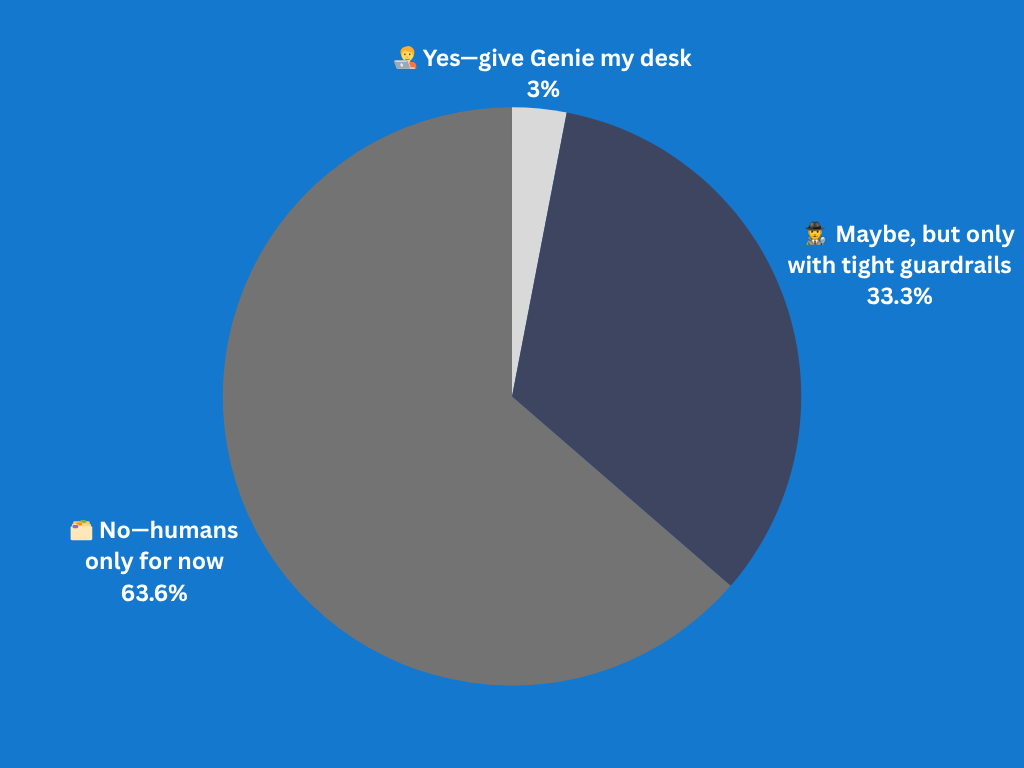
Results from Yesterday's Pulse Check |
Would you trust an AI 'coworker' to analyze and act on your internal data? |
|
|
|
GitHub Turns to AWS as AI Coding Booms |
The cloud wars get awkward when rivals become customers.
Microsoft has reportedly tapped Amazon Web Services to help power GitHub as AI-driven coding demand outpaces Azure's available capacity.
The move comes as GitHub experiences explosive growth fueled by Copilot and other AI dev tools, with the company projecting more than 14 billion code commits in 2026, up from 1 billion in 2025. |
Image created with ChatGPT |
GitHub has also faced dozens of major outages this year (including nine in May alone) as infrastructure struggles to keep up with increasing usage and competition from AI-native coding platforms such as Cursor and Claude Code. The constant downtime even drove HashiCorp co-founder Mitchell Hashimoto to publicly pull his flagship Ghostty project off the platform.
To make matters worse, Microsoft is currently facing a shareholder class-action lawsuit alleging it misled investors about Azure's growth and Copilot's actual adoption.
Microsoft says GitHub continues to follow a multicloud strategy while it works toward a long-term goal of running the platform entirely on Azure by 2027. On the whole, the decision highlights how rapidly AI-driven software development is increasing demand for cloud infrastructure—and how quickly brand loyalty evaporates when the servers catch fire. |
|
|
|
🗂️ Turn Brainstorms Into Trackable Team Tasks
Pair your AI assistant with monday.com's project management platform to convert ideas into organized boards, automate workflows, and ship deliverables faster.
📊 Supercharge AWS Log Analytics
Spin up Splunk Enterprise on an AWS AMI for a 60-day free trial—collect, index, and visualize machine data instantly to spot issues before they snowball.
💡 Level Up Projects With Top PM Picks
5 Best Project Management Software for 2026 compares monday.com, Asana, Wrike, and more, so you can match features, pricing, and integrations to your team's workflow before committing. 💻 This section contains sponsored tech insights. Advertise with us! |
|
|
|
monday.com Work OS is the project management software that helps you and your team plan, execute, and track projects and workflows in one collaborative space. Manage everything from simple to complex projects more efficiently with the help of visual boards, 200+ ready-made templates, clever no-code automations, and easy integrations. In addition, custom dashboards simplify reporting, so you can evaluate your progress and make data-driven decisions.
|
|
|
|
Security Pros Feel Increasingly Sidelined |
Cybersecurity professionals say their jobs are becoming spectacularly harder, with 68% reporting increased challenges, according to a new ISSA and Omdia survey. Ironically, this burnout is peaking just as 83% of organizations rush to adopt AI security tools. Turns out, shiny algorithms don't fix a toxic culture.
|
Image created with ChatGPT |
The study of 380 practitioners found that security teams are routinely excluded from key decisions. A staggering 72% say initiatives move forward without their input, and 79% note non-security teams are influencing security outcomes. Everyone wants to play cyber expert, which likely explains why full-time CISO roles plummeted from 76% to 63% last year. Stress is taking a toll, with nearly half of respondents having considered quitting in the past 18 months. Only 29% rated their company's cybersecurity culture as advanced.
The implications? You can't out-automate a personnel crisis. AI is a tool, not a substitute for a well-supported team. Sidelining security teams will inevitably hinder effective cyber programs. The report highlights an urgent need to involve cybersecurity earlier and invest heavily in workforce support, leadership commitment, and mentorship. |
Critical Fortinet Flaws Under Active Attack |
Threat intelligence firm Defused says attackers are actively exploiting multiple critical vulnerabilities in Fortinet's FortiSandbox threat detection platform.
While two of the flaws were patched by Fortinet in April, a third (CVE-2026-25089) was just fixed last week. Combined, these bugs allow unauthenticated attackers to remotely execute code and bypass authentication through low-complexity attacks that require no user interaction.
Defused reported observing exploitation attempts against three critical vulnerabilities, including CVE-2026-39813, which had no previously recorded exploitation activity. Amusingly, the exploit for the newest bug appears to be "vibecoded"—meaning it was likely slapped together by AI and is currently faulty.
Update your FortiSandbox, FortiSandbox Cloud, and PaaS deployments to the latest versions immediately, and review security logs for indicators of compromise. |
You just found the team that actually builds AI operations. |
AI tools are important, but not as important as knowing how to build, integrate, and operate them. Creai partners with organizations from diagnosis to deployment until real results are delivered. | Nvidia Pulls Off Massive $25 Billion AI-Era Debt Raise |
The world's favorite AI arms dealer, Nvidia, just pulled off its first corporate bond sale since 2021, scooping up a cool $25 billion. Despite initially targeting $20 billion, overwhelming investor demand peaked at $85 billion, proving Wall Street will aggressively fund a company that is already drowning in cash. The offering comes as the AI chip giant generates record revenue and cash flow, with fiscal 2026 revenue reaching $216 billion and quarterly free cash flow climbing to $49 billion. |
Image created with ChatGPT |
Nvidia structured the debt across seven tranches maturing between 2028 and 2056, giving it three decades of financial flexibility. But don't mistake this for desperation; Nvidia is merely exploiting a red-hot credit market to establish a cheap benchmark for its cost of credit.
While hyperscalers go into massive debt to buy Nvidia's chips, Nvidia is using its own multibillion-dollar piggy bank to invest in ecosystem plays like OpenAI, Anthropic, and Intel, while simultaneously boosting shareholder payouts.
Nvidia's flex shows how AI leaders are locking in cheap capital simply because they can. For enterprise buyers, it offers another lens into the financial health of a key AI infrastructure provider that continues to print money faster than it can spend it. |
|
|
|
|
Senior Staff Writer at TechnologyAdvice |
Luis Millares is a seasoned tech writer with broad experience reviewing consumer gadgets and enterprise software, offering clear, reliable insights across the latest in technology. |
|
|
|
Curious about where AI is really headed? |
The Neuron cuts through the noise to bring you smart, hype-free takes on the latest AI trends, tools, and breakthroughs. Join 700,000+ professionals from top companies like Microsoft, Apple, Salesforce, and more.
|
|
|
|
Advertise in Daily Tech Insider! Daily Tech Insider is a TechnologyAdvice business. © 2026 TechnologyAdvice, LLC. All rights reserved.
TechnologyAdvice, 3343 Perimeter Hill Dr., Suite 215, Nashville, TN 37211, USA. |
|
|
|
|