







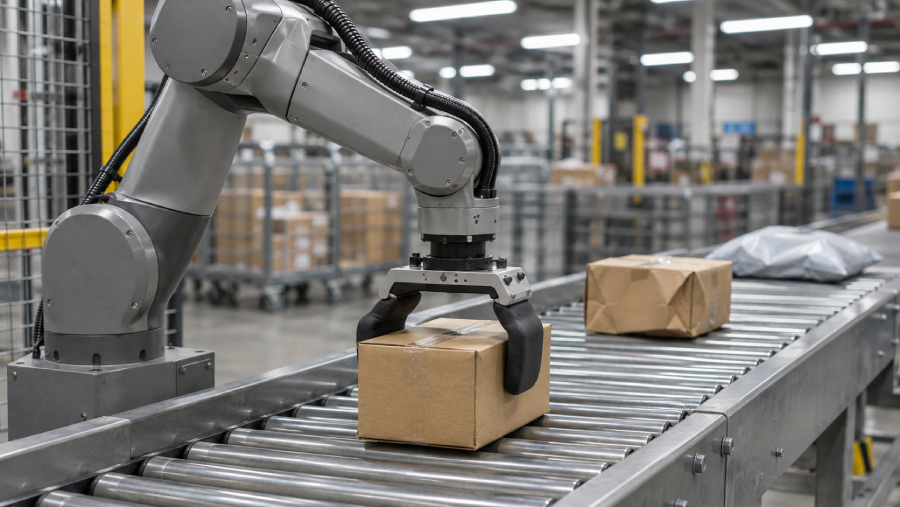
A neat cardboard box makes for a good robot demo. A sagging mailer that snags on a conveyor is a better test.
On Nov. 24, postal operator Pos Malaysia and Chinese robotics developer X Square Robot announced an agreement to explore using robots for parcel handling, sorting, and other logistics tasks. It’s a memorandum of collaboration, not a deployment or even a confirmed trial. The companies say any evaluation or deployment would require a separate written agreement.
The interesting question isn’t whether a robot can pick up a parcel. It’s about whether it can handle the ones that slow people down without adding another reason for the line to stop.
What the companies have agreed to
X Square Robot intends to provide equipment for evaluation, while Pos Malaysia would bring its experience running a postal network. The announcement doesn’t name a sorting site, a robot model, a timetable, or performance targets. It doesn’t say anyone has bought robots or put them to work.
The announcement calls the technology “embodied AI.” Here, that means software that helps a machine make sense of its surroundings and act on what it sees. We’ve covered X Square’s Wall-B household robot, but there’s no indication that Wall-B is the machine Pos Malaysia would evaluate. The work on a sorting floor is different, and the companies haven’t said what hardware they’d use.
What eWEEK found: The awkward parcels are the better test
Pos Malaysia describes its sorting centers as semi-automated.
The question, then, is where a new robot could help the system already in place. A conveyor that reliably handles ordinary boxes doesn’t need a robot just because a robot can do the same job. An exception lane, where staff deal with parcels the equipment can’t handle, is a more useful place to look.
The distinction matters because a smooth demo tells you little about a full shift. As our warehouse robot comparison explains, useful metrics include how often people step in and how much work gets done after downtime is accounted for. Our look at GXO’s Apollo trials showed why that evidence matters: visible progress in testing is different from public results that tell operators how the robot performs on the job.
| What to test | What would count |
| Crushed cartons, soft mailers, and awkward shapes | How many parcels reach the right lane without damage or rework |
| Jams and failed picks | How often someone steps in and how long it takes to get the line moving again |
| Normal and peak volumes | Correctly sorted parcels per hour, including stoppages, versus the current process |
Those are suggested measures, not results the companies have reported. If the robot clears nine awkward parcels but stalls the line on the tenth, the time it takes to recover belongs in the score.
What logistics teams can do before buying
If you run a sorting operation, start with a real bottleneck. For one shift, log which parcels staff pull off the line, why they pull them, and how long it takes to get each one moving again. That gives you a baseline before a vendor shows up with a handpicked set of boxes.
Then compare the robot with the simplest alternative: a change to how parcels are fed onto the line, a scanner adjustment, or a better-staffed exception station. Run both options on a comparable parcel mix and include the time staff spend supervising and recovering from stoppages. A faster pick means little if the next station has to undo it.
For Pos Malaysia, the next development worth watching is a signed evaluation with a named task and a clear baseline. Until then, the agreement tells us where the companies want to look, not whether a robot can make the shift run better.
Related reading: See what Boston Dynamics and GlobalFoundries plan to test with Atlas before putting humanoid robots to work in chip plants.