







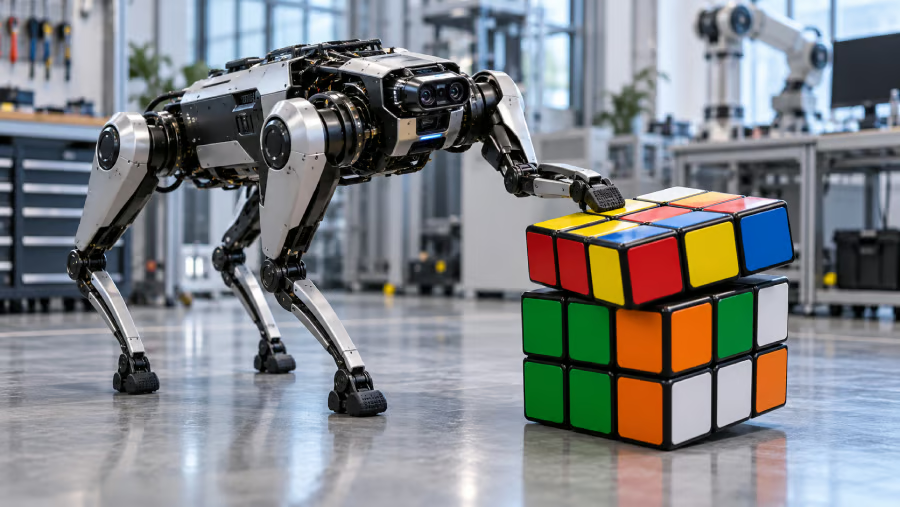
Rubik's Cubes are usually a test of quick fingers. At ETH Zurich in Switzerland, a four-legged robot solved an oversized one using its feet while keeping its balance.
ETH Zurich's ANYmal-D robot completed three solves of a 4.6-kilogram Rubik's Cube, each taking eight to nine minutes. Using onboard cameras, a solving algorithm, and coordinated foot movements, the robot manipulated the puzzle without a separate robotic arm.
The demonstration points to a potentially useful direction for robotics: machines that can manipulate objects using the same limbs they rely on for movement. But whether those skills can transfer to industrial environments remains an open question.
ETH Zurich turns walking legs into puzzle-solving tools
IEEE Spectrum featured the Swiss lab's demonstration on Oct. 23. Instead of following a remote operator's commands, the quadruped examined the cube, planned its solution, and carried out the movements independently.
Interesting Engineering reported that the roughly 10-pound puzzle required precise force: one wrong layer turn could spoil the solution, while an uncontrolled push could upset the robot's balance.
According to ETH Zurich's Robotic Systems Lab, the robot used onboard RGB-D cameras to identify the cube's colors and position, followed by a solving algorithm to plan its moves. Reinforcement-learned controls handled flips and turns, with one foot holding the cube steady while another rotated a layer.
What eWeek found: Promising tests, unanswered field questions
A review of ETH Zurich's published results shows more than a successful video, but also important limits. The figures below describe separate experiments, not a proven industrial success rate.
Tested capability | Reported result | Remaining question for industry |
| Complete puzzle solves | Three autonomous runs, about 30 steps and 8–9 minutes each | Can performance hold across many trials? |
| Color recognition | 100% accuracy indoors; 98.7% outdoors in evaluated sequences | How well does it handle poor lighting and dirty surfaces? |
| Cube localization | About 2 cm median position error and under 3 degrees rotation error up to 2 m | Can it work with smaller controls and tight clearances? |
| Foot manipulation | Coordinated pinning, rotation, and flips | Can these skills transfer to unfamiliar tools and fixtures? |
| Disturbance testing | Individual skills on low-friction flooring and cobblestones, plus external pushes | Can it finish entire jobs under changing site conditions? |
The key distinction is between demonstrating individual manipulation skills and combining them into reliable work.
Turning a cube layer, stabilizing an object, and recovering from a disturbance are useful capabilities, but industrial tasks introduce additional variables, including unfamiliar equipment, changing resistance, and limited room for error. The research shows that foot-based manipulation is possible; it does not yet establish that those movements can be transferred reliably to different tasks or environments.
The robot's learned movements came from a teacher-student process: policies learned with privileged simulation data were adapted for deployment using onboard depth images and body feedback. The team also tried individual skills on a small box and a cylindrical container, but did not demonstrate full industrial jobs.
RoboticsIntl noted that eliminating a dedicated arm could reduce weight, power use, and mechanical complexity. It also identified ANYbotics as an ETH spinout commercializing the ANYmal family. Neither commercial savings nor deployment of this cube-solving capability has been established.
Swiss findings pose practical questions for EMEA operators
For Swiss manufacturers and industrial operators across EMEA, the appeal is a mobile robot that could eventually inspect facilities, turn valves, or clear obstructions without carrying a separate robotic arm. Using existing legs for movement and manipulation could reduce hardware weight and mechanical complexity, although ETH Zurich has not demonstrated these industrial applications or established commercial savings.
The challenge is making those capabilities work outside controlled demonstrations. Industrial equipment varies in shape, resistance, and accessibility, while uneven surfaces can complicate a robot's balance. A system would also need to recognize unsuccessful movements, adjust its approach, and recover safely without damaging equipment.
Before considering a pilot, engineering and procurement teams should evaluate:
- Task-specific performance: Request repeated demonstrations involving actual doors, valves, and controls, including success rates, completion times, and recovery from failed attempts.
- Operational reliability: Assess performance under poor lighting, uneven terrain, changing surface conditions, and extended operation rather than relying on isolated demonstrations.
- Cost and safety: Compare potential hardware savings with the expenses of supervision, maintenance, downtime, and safeguards needed when robots interact with workers or critical equipment.
For organizations in Switzerland and across EMEA, the next meaningful milestone would be successful field trials showing that foot-based manipulation can complete practical tasks consistently and safely.
ETH Zurich's experiment offers a promising direction for robots capable of doing more with their existing hardware. However, until researchers demonstrate measurable performance and cost advantages in real industrial environments, the technology remains an exciting research achievement rather than an immediate reason to change procurement plans.
Also read: South Korea's Spider 30 takes a different approach to robotic mobility, climbing steel walls and performing tasks upside down.