







Buying a robot in Qingdao now looks a little more like shopping for a car than ordering another gadget online.
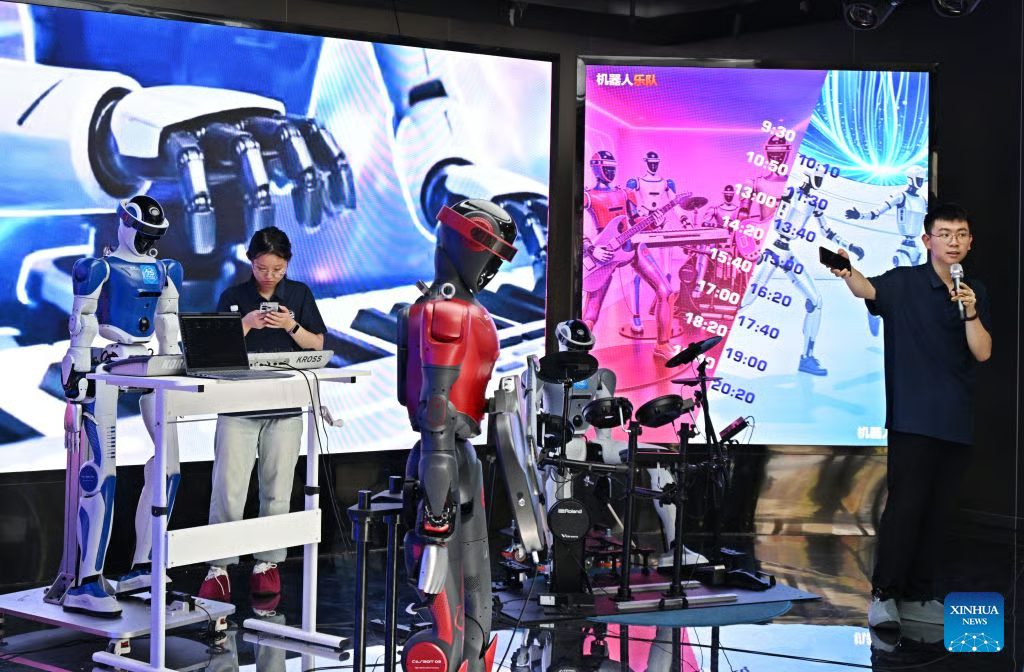
Qingdao in eastern China’s Shandong province has opened its first robot 6S experience store, allowing consumers to interact with and test a range of robotic products, according to Xinhua.
The store brings six functions under one roof: sales, spare parts, service, surveys, leasing and personalized customization. Visitors can watch robots perform, play Chinese chess against one, control a machine playing soccer and try a robot dog toy, Xinhua reported.
The format gives consumers a way to experience robots before deciding whether to buy, lease or customize one. It also creates a physical place where manufacturers and customers can see how the machines perform outside a controlled product demonstration.
China is bringing robots into everyday spaces
The opening reflects a broader shift in China’s robotics strategy. Rather than limiting robots to factories and research labs, companies are increasingly placing them in public-facing environments where people can see, touch, and experiment with them.
That approach has been gaining momentum across the country. Hong Kong is preparing to open a 24-hour convenience store operated by a humanoid robot called “Xiao Gai,” a project intended to make embodied AI more visible in everyday retail settings. Shenzhen is also developing what it describes as the world’s first fully robot-run hotel, where robots are expected to handle check-in, luggage delivery, room service, cleaning, and security.
Taken together, the projects suggest that China is treating retail and hospitality as testing grounds for consumer-facing robotics, where public acceptance may be just as important as technical performance.
The retail test
Qingdao’s 6S model could prove useful because buying a robot differs from buying a phone or an appliance. Consumers may need to see what a machine can actually do, understand maintenance requirements and determine whether it fits a particular task before spending money.
The six-part model also tackles a practical problem: ownership does not end at purchase. Spare parts, servicing, leasing and customization could become just as important as the machines themselves as robots become more common.
That said, the technology still faces limitations. Many service robots remain specialized, require maintenance and software support, and may struggle with unpredictable real-world situations. The challenge is no longer only building capable robots, but building the ecosystem that convinces ordinary people they are useful enough to bring home.
As China moves robots into stores, hotels and dedicated experience centers, the next challenge may be less about making the machines impressive and more about making them ordinary. Qingdao’s 6S store is an early test of whether demonstrations, service and hands-on access can turn curiosity about robots into actual demand.
Related News: WIRobotics put its ALLEX humanoid robot through a power-drill test, highlighting the push to make robots capable of handling tools and practical real-world tasks.