







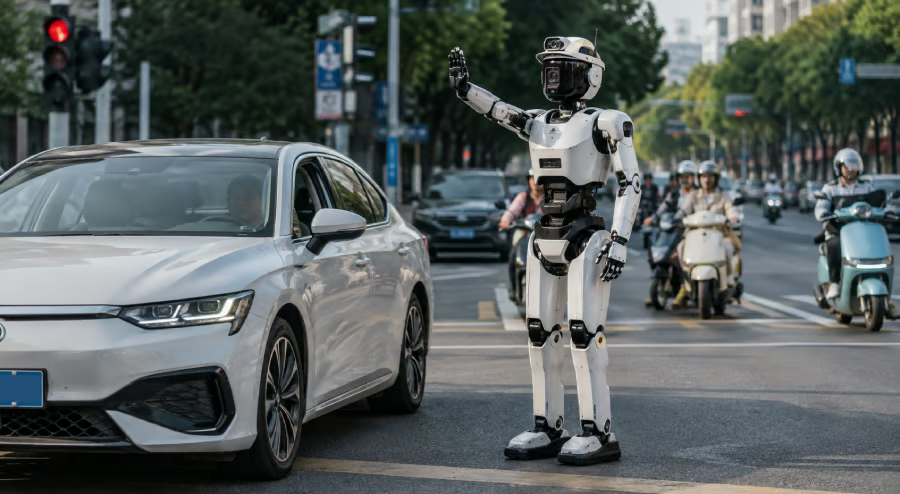
On the streets of Hangzhou, China, traffic duty is getting a robotic assist. Since May, SUPCON Information has deployed 15 T2 robots that can spot helmetless e-bike riders, flag vehicles over stop lines, and wave traffic through with synchronized arm gestures.
SUPCON says the fleet has issued more than 170,000 warnings and helped reduce some traffic violations by more than 40%.
The pilot is also expanding beyond Hangzhou as China tests the robots in more routine public-service roles. SUPCON expects deployments to approach 200 by year-end as China tests the robots in more routine public-service roles.
The robots are still assistants, not officers. They cannot make arrests or issue tickets, and their job is built around repetitive traffic-control tasks.
What Hangzhou’s robot traffic cops can do
Reuters reported that the 98-kilogram T2 uses cameras, radar, and onboard computing to identify helmetless riders, e-bikes carrying passengers, vehicles stopped over marked lines, and pedestrians crossing against signals.
The machines can also answer questions about directions, parking, and traffic rules. An emergency function connects users with local police, while seven-jointed arms reproduce standard traffic-police gestures in sync with traffic lights.
SUPCON said the robots run autonomously from 7 a.m. to 6 p.m., moving between preset positions without remote control. A central platform lets traffic-police teams monitor and dispatch them.
The company says violation-recognition accuracy exceeds 95%, although strong sunlight, rain, and temperature extremes can still interfere with cameras and radar.
“It doesn’t get tired. It can work steadily for long periods,” SUPCON’s Cao Hui said, according to Reuters.
China is widening the rollout
Hangzhou is no longer the only test bed. SUPCON says nearly 50 traffic robots are operating across about eight cities in three Chinese provinces, and it expects that number to approach 200 by the end of 2026.
According to Technology.org, Hangzhou had previously tested a single AI traffic robot in its Binjiang district before deploying a 15-robot group around the West Lake area during the May Day holiday. Similar units also appeared in Kashgar and Ordos.
Traffic control may suit today’s robots because the work is narrow and predictable. Standing at fixed locations, repeating known gestures, and issuing scripted warnings requires less adaptability than many factory or household jobs.
Southeast Asia could be next for China’s traffic robots
Chinese robotics companies are also looking beyond the domestic rollout. The Independent said Chery-backed AiMOGA sees potential in overseas markets where traffic officers work in difficult roadside conditions, including Southeast Asia’s long rainy seasons.
Getting the robots onto streets elsewhere in the region would be more complicated than shipping the machines overseas. AiMOGA executive Zhang Guibing said they would need to work with local law-enforcement IT systems, obtain certifications, and comply with data-protection rules because they rely on cameras and other sensors.
Hangzhou offers a fairly specific use case for now: robots handling repetitive intersection duties while human officers remain in charge of enforcement. If Chinese vendors take the same model into Southeast Asia, adapting to local police systems, certifications, and privacy rules could matter just as much as whether the robots can direct traffic.
More from China’s robotics push: The World Robot Conference is putting the country’s humanoids to the factory test, as developers try to prove they can handle real work beyond staged demos.