






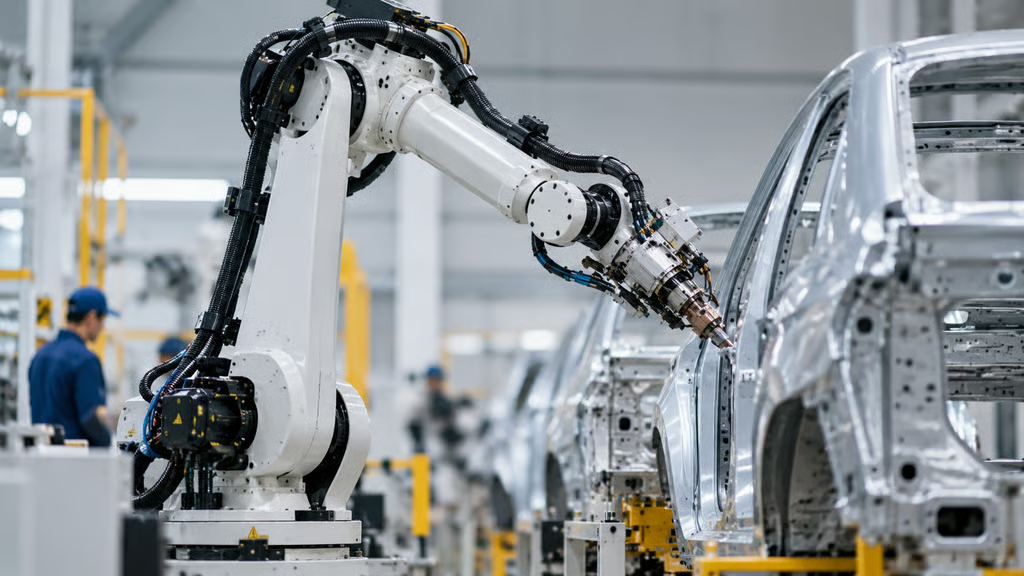


Factory floors are getting more crowded, and humans are not the only ones clocking in. The global industrial robot population has now passed 5 million.
Factories installed more than 600,000 industrial robots in 2025, pushing the operational stock up 9% to 5 million units. Asia recorded the strongest growth, but the region is moving at very different speeds.
China is expanding at unmatched scale, India is growing quickly from a much smaller base, and mature markets such as Japan and South Korea are adding robots more slowly. For manufacturers and robotics suppliers, those differences matter because APAC is no longer one automation story.
China dominates global robot installations
According to the International Federation of Robotics (IFR), China installed 354,000 industrial robots in 2025, up 20% from a year earlier. The country accounted for 59% of global deployments, while Chinese manufacturers supplied 195,000 units and captured 55% of their domestic market.
“The strongest growth is taking place in Asia,” IFR President Jane Heffner said. She added that the 5 million robots operating globally are more than double the number recorded seven years earlier.
China’s lead is substantial. The Robot Report, citing the IFR data, noted that China remained by far the world’s largest industrial robot market as installations continued climbing in 2025.
India emerges as a fast-growing automation market
India remains far smaller than China, Japan, or South Korea in absolute installations, but its recent growth stands out.
Business Wire’s publication of the IFR findings reported that India installed almost 10,500 industrial robots in 2025, up 15% year over year and enough to rank sixth worldwide. Annual installations grew at an average compound rate of 27% between 2020 and 2025.
The same data showed a different picture in Asia’s more established robotics markets. Japan installed 36,219 robots in 2025, down 19%, while South Korea installed about 30,000 units, down 1%. IFR said South Korean installations have remained around 31,000 units annually since 2019.
What eWeek found
A comparison of IFR’s 2025 figures shows that Asia’s automation lead is being shaped by markets moving at markedly different speeds.
Market | 2025 robot installations | Annual change | What the data shows |
| China | 354,000 | +20% | Dominates global deployments while continuing to expand |
| Japan | 36,219 | -19% | Remains a major market despite a sharp annual decline |
| South Korea | ~30,000 | -1% | Large market with relatively flat installations |
| India | ~10,500 | +15% | Smaller market with rapid recent growth |
China installed nearly 10 times as many industrial robots as Japan and more than 30 times India’s total in 2025.
India’s story is different. Its current deployment volume is still modest by regional standards, but IFR’s 27% average annual growth rate from 2020 to 2025 points to a market expanding much faster than its size alone suggests.
For manufacturers and robotics suppliers, the comparison shows why APAC cannot be treated as a single automation market. China is about scale, India is about acceleration, and Japan and South Korea increasingly represent mature markets where growth is less explosive.
Robot demand is expected to keep climbing
IFR forecasts global installations will rise another 9% to 655,000 units in 2026 and reach 806,000 by 2029.
The organization pointed to supply-chain resilience, manufacturing relocation, labor shortages, demographic change, AI, machine vision, sensing, easier programming, and system integration as factors supporting longer-term demand.
For APAC, the numbers put China and India at two very different points in the automation race. China already operates at a scale no other market approaches, while India’s faster recent growth makes it a market worth watching as the global robot population continues to rise.
For a closer look at where APAC robotics is headed next, read our list of robots to watch in 2026, covering humanoids, robot dogs, and real-world AI systems across the region.