







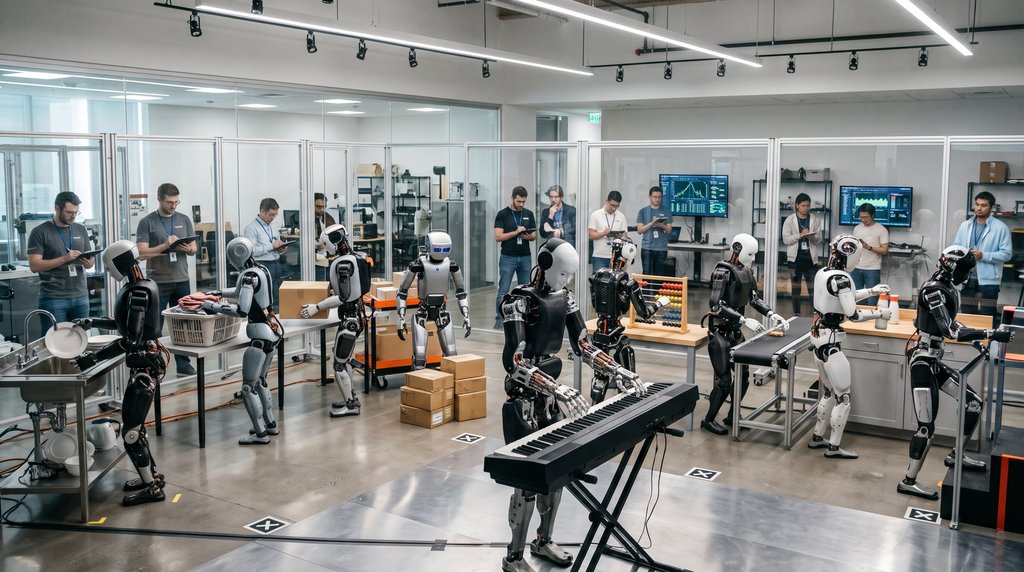
The best model in a new humanoid robot benchmark could play a toy piano. It couldn’t get a single item of laundry into the washing machine.
OpenAI’s GPT-6.2 Astra outperformed rival models from Anthropic and Google in a new humanoid robotics benchmark released by Artificial Analysis on Nov. 25. Researchers put some of the world’s most advanced AI systems in charge of a simulated humanoid robot.
The results showed a gap between getting the robot across a room and getting it to pick something up once it arrived.
Nine frontier AI models put their skills to the test
Artificial Analysis’s AA-Robotics-Sim v0.1 evaluates nine language models using a virtual version of the Unitree G1 humanoid, equipped with 29 joints, three-fingered hands and a head-mounted camera. Each AI writes and executes code to direct the machine, with a separate controller keeping it balanced.
Researchers gave each model five practice runs per task to develop strategies and save instructions. During evaluation, the AI faced unfamiliar scenes with changes to room layouts, lighting, and other environmental details.
OpenAI claimed two of the top three spots across the 10 household and industrial assignments.
Rank | AI model | Mean evaluation score |
|---|---|---|
1 | GPT-6.2 Astra | 71.0 |
2 | Claude Fable 5.2 | 57.5 |
3 | GPT-6.2 Sol | 53.7 |
4 | Claude Opus 5.5 | 48.2 |
5 | Gemini 4 Neon | 46.2 |
6 | GPT-6 Astra | 46.1 |
7 | Gemini 4 Argon | 45.5 |
8 | GPT-6.1 Sol | 33.1 |
9 | Claude Fable 5.1 | 29.1 |
Astra finished 13.5 points ahead of its closest competitor. Scores are measured out of 100 and include partial credit, so an unfinished assignment can still earn points.
Even the smartest AI models can’t handle laundry day
Not a single piece of laundry made it inside the washing machine during the evaluation. Across 90 dishwasher trials, the models managed to place only five dishes in the rack.
Researchers identified grasping as a persistent problem. Every successful attempt to move a box onto a shelf involved pressing it between the robot’s palms without closing its fingers around it.
Elsewhere, all nine models earned full marks in warehouse navigation, maneuvering around packages without moving them. Astra also aced the piano, abacus and conveyor assignments, completing 61 of its 100 scored attempts across the entire benchmark.
Artificial Analysis went a step further by introducing a breakable dish in a separate experiment. Despite being told that the dish was fragile, seven models broke it at least once, including Astra.
What eWeek found: Better robot controls could improve performance without a new AI model
After examining a separate physical robotics experiment by Robocurve, eWeek found that changes to Astra’s robot control software cut the median time needed to complete a task by roughly three-quarters. No model upgrade was involved.
During the humanoid benchmark, the simulated robot spent only a small fraction of each session moving.
Robocurve explored a related problem by introducing tools developed through OpenAI’s Codex that allowed Astra to adjust movement speeds and send multiple commands without repeatedly waiting for another AI response.
Researchers compared the original and modified controls using the same model-call allowance and asked physical robotic arms to stand three bottles upright.
Performance metric | Original controls | Modified controls |
|---|---|---|
| Successful attempts | 5 out of 10 | 10 out of 10 |
| Median completion time | 16.6 minutes | 4 minutes |
| Average AI processing cost per attempt | $164.34 | $12.72 |
Companies developing robots or introducing them into warehouse and factory operations could apply a similar approach before paying for a more advanced AI model. Test different control configurations using the existing machine and keep its safety limits unchanged.
- Measure productivity. Have the robot repeatedly pick up and position actual inventory. Count how many items it correctly places per hour.
- Track human intervention. Record how often employees must reposition an object or restart a failed operation.
- Calculate the cost of completed work. Include AI processing charges from failed attempts when working out how much each successful operation costs.
A robot that spends less time waiting for its next instruction could get through considerably more inventory during a working day. Businesses should find out how much of that improvement they can achieve with the AI model they have today.
AI models are learning to handle tasks that go well past conversations, including controlling simulated humanoid robots. Knowing how to give AI clear instructions remains a useful skill. Learn practical prompting techniques with our free six-minute How to Talk to AI course, then Explore courses from The Neuron Academy free for seven days.