







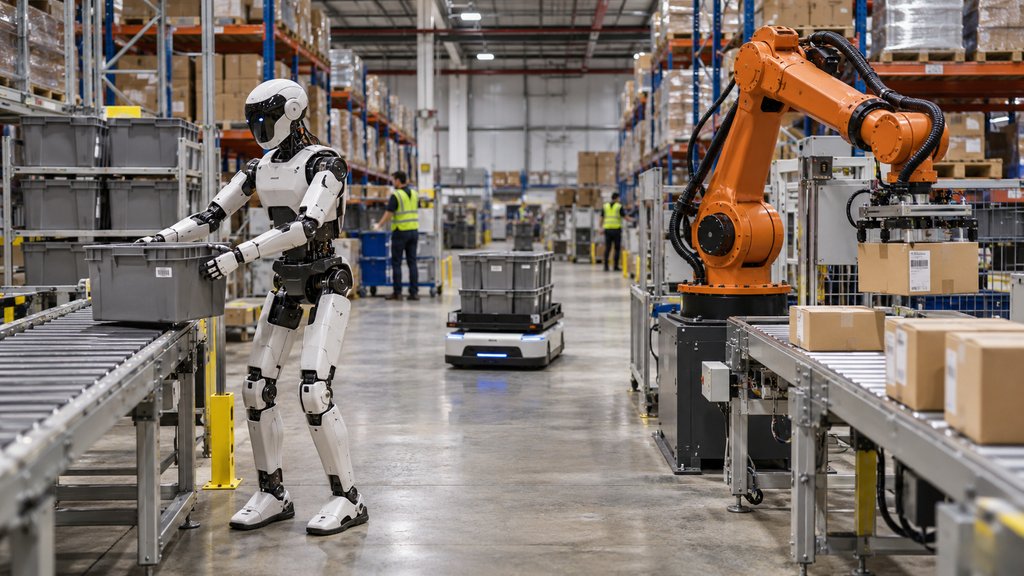
A warehouse does not need a robot that walks like a person if a wheeled machine can do the job better.
Humanoid robots are beginning to move beyond demonstrations and into everyday warehouse tasks. Agility Robotics' Digit has transferred more than 100,000 totes at GXO, while Boston Dynamics' Stretch was designed specifically to unload trailers. Both perform useful work, but they approach warehouse automation in very different ways.
For warehouse operators, the question is not whether humanoids are more impressive than traditional robots. It's whether their flexibility can justify the cost when specialized machines already handle many tasks. The answer depends on the job, the facility, and how reliably each robot performs.
- Humanoid warehouse robots are moving from pilots to defined jobs
- Traditional robots are built for specific warehouse bottlenecks
- Mixed fleets may be more useful than one robot type
- What eWEEK found: Specialized robots handle most jobs, while humanoids fill the gaps
- Test completed work before choosing a robot
- Warehouses may need both humanoid and traditional robots
Humanoid warehouse robots are moving from pilots to defined jobs
Some humanoids are already performing routine warehouse tasks, while others are still being tested to see how well they work in real-world operations.
Digit already handles totes at GXO
At GXO's Georgia warehouse, Agility Robotics' Digit transfers totes onto conveyors alongside existing automation. GXO and Agility reported more than 100,000 tote transfers in October and plan to add the robot at two other US facilities in early 2027.
That is evidence of a commercial application, not proof that humanoids outperform conventional machines. The companies have not published directly comparable hourly throughput, intervention rates, or cost per tote.
Apollo and Figure are testing broader handling work
GXO completed an Apptronik pilot involving small-item picking earlier in 2026. Its proposed expansion to as many as 1,000 Apollo robots depends on further trials and agreed safety and productivity targets. The robots are not already operating as a 1,000-unit fleet.
Apptronik's Apollo 2 is offered in wheeled and bipedal configurations, an important reminder that humanlike handling does not always require two legs.
Separately, Figure said its Helix 02-powered humanoids handled 249,560 packages during a 200-hour livestream in May, according to Ars Technica. Although the demonstration showed the robots performing a repetitive task over an extended period, the results were not independently verified in a commercial warehouse.
Traditional robots are built for specific warehouse bottlenecks
Unlike humanoids designed to handle different tasks, traditional warehouse robots typically specialize in specific jobs, such as moving inventory, picking products, or unloading shipments.
Amazon separates transport from picking
Amazon's Hercules moves loaded shelving units; Sparrow picks products into totes; and Vulcan picks and stows inventory. The company described these systems for its planned Brisbane fulfillment center, expected to open in 2028. That facility does not yet have operating results.
Specialized systems can be efficient when routes, products, and workstations are predictable. The downside is that installing them may require redesigning storage layouts or integrating additional conveyors and software.
Stretch unloads trailers; UnboxSort sorts parcels
Boston Dynamics designed Stretch Gen 2 for trailer unloading. It claims a maximum rate of 1,000 cases per hour, depending on carton weight and stacking. That is a manufacturer specification, not a verified full-shift average.
Unbox Robotics' UnboxSort uses purpose-built machines to route parcels through logistics facilities. Neither system needs all the movements of a general-purpose humanoid to perform its assigned job.
Mixed fleets may be more useful than one robot type
In May, LG CNS demonstrated a humanoid packing a box, a four-legged robot carrying it, and a wheeled robot shelving it. The machines coordinated through a shared system, although the demonstration did not establish commercial savings.
Gartner forecast in January that fewer than 20 companies would bring humanoids into supply-chain or manufacturing production by 2028. Integration, costs, dexterity, and battery life remain obstacles. A mix of purpose-built and flexible robots may therefore make more sense than replacing existing equipment.
What eWEEK found: Specialized robots handle most jobs, while humanoids fill the gaps
The documented deployments suggest that specialized robots remain a practical starting point for repetitive, high-volume warehouse tasks. Humanoids may offer more value where work varies, equipment must operate at existing human-designed stations, or redesigning a facility would be difficult.
That distinction matters because automation costs extend beyond the robot itself. Fixed systems may require changes to storage layouts, conveyors, and workflows, while more flexible machines could reduce some of those requirements. However, humanoids still need to demonstrate that their reliability, throughput, and operating costs justify deployment.
These conclusions are based on publicly reported applications and manufacturer disclosures, not controlled head-to-head testing.
Warehouse task | Best starting point | When to consider humanoids |
|---|---|---|
Move goods or loaded shelves | Autonomous mobile robots (AMRs), such as Hercules | Few advantages on predictable routes |
Retrieve goods from dense storage | Automated storage and retrieval systems | Limited benefit in purpose-built racks |
Pick and stow individual items | Robotic arms, such as Sparrow and Vulcan | Varied goods at existing manual stations |
Sort parcels | Dedicated sorters, such as UnboxSort | Pilot for variable handling; Figure has demonstrated it |
Transfer totes to conveyors | Fixed transfer equipment | Digit has a commercial handoff role |
Unload trailers | Mobile unloading robots, such as Stretch | Limited comparative evidence today |
The table is a starting guide, not a universal ranking. Product variety, aisle design, available space, and existing equipment can change the recommendation.
Test completed work before choosing a robot
Performance figures can be difficult to compare because robots handle different tasks under different conditions. Warehouse operators should focus on how each machine performs on the same workload over a full shift, rather than relying on headline numbers alone.
Pilot measure | What to track |
|---|---|
Throughput | Successful picks, totes, or cases per hour |
Human assistance | Resets and manual corrections per 1,000 tasks |
Reliability | Downtime, charging, repairs, and missed shifts |
Quality and safety | Mispicks, product damage, and safety incidents |
Total cost | Fees, installation, maintenance, energy, and staff time |
These measurements provide a starting point for comparing robots, but buyers also need to understand how each machine would fit into their existing operations.
Questions to ask vendors
Before committing to a pilot, warehouse operators should ask:
- Can the robot handle fragile, awkward, and unfamiliar inventory?
- Will it connect to the warehouse management system and conveyors?
- Who intervenes when it gets stuck, and how often does that happen?
- Does cost per successful task improve after all support expenses?
The answers can help narrow the options and identify which robots are worth testing.
Use the selection guide to narrow a pilot
The next step is to match the technology to the warehouse task. The guide below covers AMRs for transport, specialized robots for sorting and unloading, and humanoid or wheeled-manipulator pilots for more varied work.
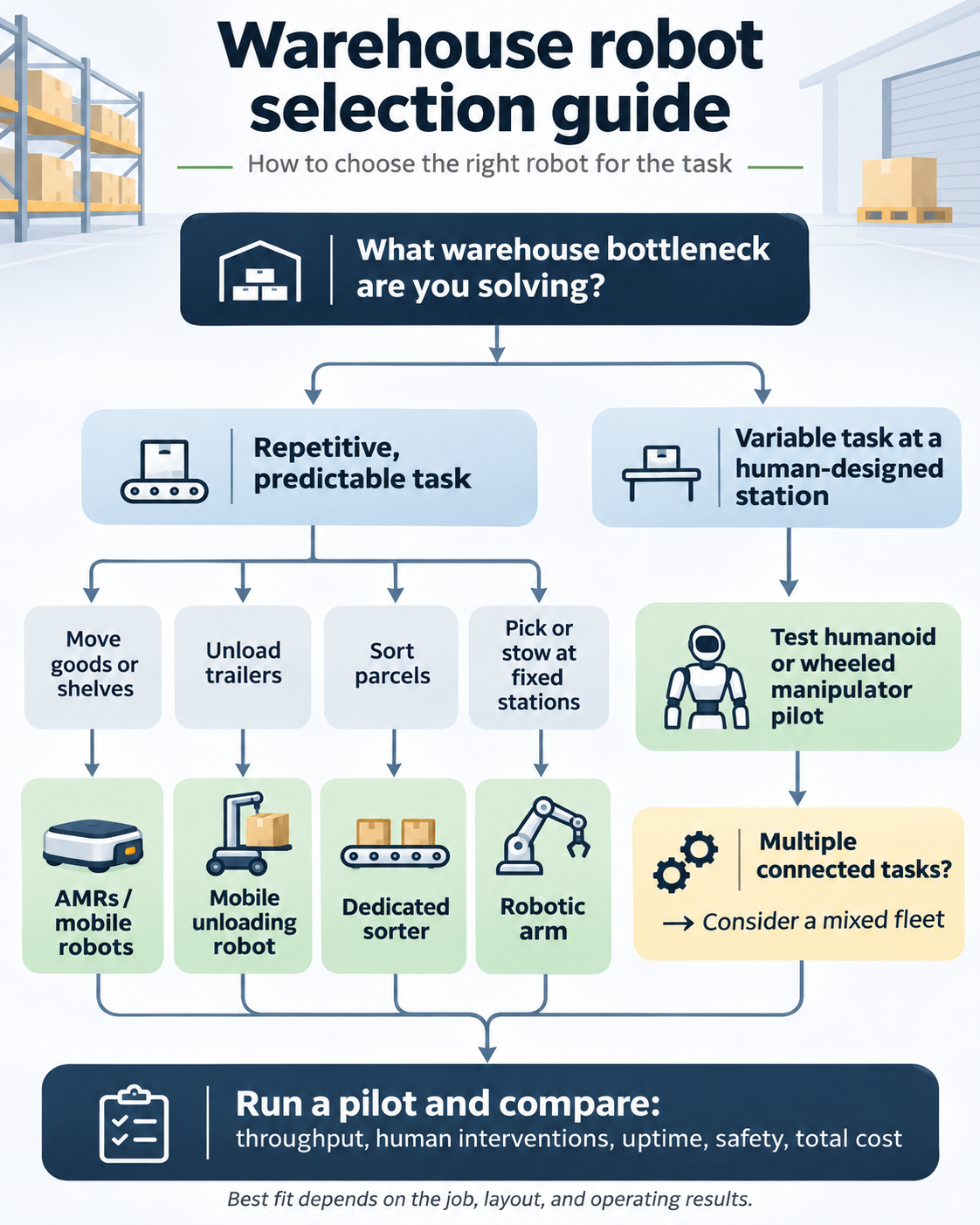
Once a suitable robot has been identified, operators can test its performance against existing processes before expanding deployment.
Warehouses may need both humanoid and traditional robots
Traditional robots already handle many of the repetitive tasks that keep warehouses running, while humanoids are beginning to demonstrate their usefulness in selected workflows. Neither approach is likely to fit every operation.
The more interesting development is how these technologies could work together. Specialized machines can handle predictable, high-volume jobs, while flexible robots may eventually take on tasks that are difficult to automate without redesigning existing facilities.
For warehouse operators, the next step is not choosing sides. It's determining where each type of robot can deliver measurable improvements in productivity, reliability, and cost.
Also read: Thinking about bringing a humanoid into your warehouse? Check how much humanoid robots actually cost before planning a pilot.