






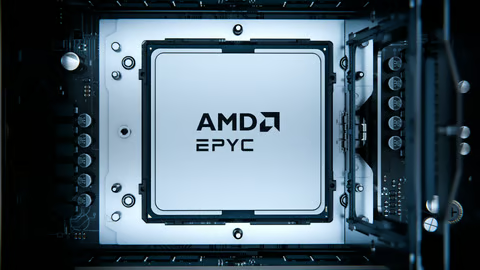


AMD says its EPYC 9996 “Venice” server processor delivers 2.24× the platform-level SPECrate 2026 Integer throughput of Nvidia Vera, putting a striking number behind its push for x86 CPUs in next-generation AI infrastructure.
The comparison does not measure the processors at similar core counts. Each EPYC 9996 has 256 cores and 512 threads, compared with Vera’s 88 cores and 176 threads. In AMD’s separate comparison using a 96-core Venice configuration, the claimed advantage drops to about 20% per core.
AMD’s 2.24× claim measures platform throughput
AMD published the figures Sept. 18 as part of a broader performance case for 6th Gen EPYC 9006 processors across enterprise, cloud, AI, and high-performance computing workloads. Its benchmark disclosure lists an estimated SPECrate 2026 Integer score of 2,070 for a two-socket EPYC 9996 system and 925 for a two-socket Vera platform.
AMD describes the figures as preliminary performance estimates based on engineering projections and subject to change. Its current methodology lists GCC 15.2 for both systems in the 2.24× comparison.
Venice will also serve as the CPU in AMD’s Helios rack-scale AI platform, alongside Instinct accelerators and Pensando networking. Nvidia’s Vera CPU has 88 Olympus cores, 176 threads, up to 1.5TB of LPDDR5X memory, and up to 1.2TB/s of memory bandwidth. Vera Rubin systems are already planned for deployments including OpenAI-backed data centers in Malaysia.
AMD’s closer core-count estimate uses a 96-core 6th Gen EPYC configuration. It scores 1,210, or 6.3 per core, versus 925 and 5.3 per core for Vera — roughly a 1.2× per-core advantage.
AMD also projects 3.4× the rack-level throughput of a Vera-based platform under a modeled 100-kilowatt power limit. The calculation covers six workloads; it is not a measured head-to-head rack deployment.
SPEC’s CPU 2026 rules permit estimated performance figures when clearly identified as estimates. Published SPEC results carry additional reproducibility and disclosure requirements.
What eWeek Found: Core density drives much of AMD’s 2.24× lead
AMD’s figures show that core density accounts for much of the headline advantage. A two-socket EPYC 9996 system has 512 CPU cores, compared with 176 in a two-socket Vera system. The 2.24× throughput estimate therefore does not mean an individual Venice core is more than twice as fast.
AMD’s closer comparison reduces the claimed advantage to about 20% per core, using 96-core Venice against 88-core Vera. High core counts are becoming a wider server-CPU battleground, with Intel’s upcoming 256-core Diamond Rapids Xeon also targeting AI and data-center workloads.
Higher density can affect server consolidation, rack utilization, software licensing, power requirements, and workload placement. The broader platform choice still depends on memory bandwidth, x86-versus-Arm compatibility, CPU-GPU integration, application performance, and total cost of ownership.
AMD’s estimates support a case for Venice’s throughput density, but independent production-system testing is still needed to establish how the two platforms compare in enterprise AI deployments.
Read more: AMD is pursuing another approach to inference infrastructure as AMD and Cerebras split AI inference across Helios and wafer-scale processors to target latency and infrastructure efficiency.