







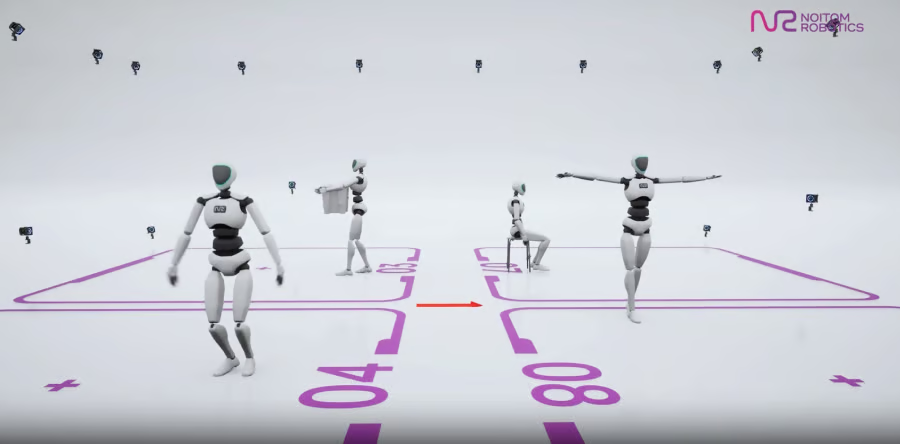
In a major boost to the open-source embodied AI community, motion-capture specialist Noitom Robotics just gave humanoid robots a massive, free library of human movement.
The company announced the public release of HiPHI on Wednesday at the World Robot Conference (WRC) 2026 in Beijing. Spanning 617.5 hours of high-precision motion capture, the benchmark, as Noitom described it, is one of the largest high-precision human motion datasets ever made public.
This is aimed directly at training whole-body locomotion and manipulation policies for humanoid robots.
HiPHI includes 371.8 hours of whole-body movement and 245.7 hours of human-object interaction involving 40 physical objects. The data was captured from 132 performers at 90 Hz with sub-millimeter precision, pairing skeletal motion with synchronized 3D object meshes and trajectories.
Unlike traditional motion capture libraries organized by session timestamps, HiPHI organizes actions using FrameNet semantic indexing. This structure lets Vision-Language-Action (VLA) models naturally link language commands to structured physical actions.
Noitom said policies trained on the data have already demonstrated running, sitting, crawling, carrying a box, and pulling a suitcase on a physical Unitree G1 humanoid.
“The bottleneck in physical AI is not how much data exists, but how much of it a machine can actually learn from,” said Dr. Tristan Ruoli Dai, Founder and CEO of Noitom Robotics.
From human movement to robot training
The dataset is free for non-commercial research on Hugging Face under the ModalityNet Open Research License v1.0, while enterprise access is offered through ModalityNet.
The free release could lower the barrier for universities and independent researchers that cannot afford proprietary motion-capture datasets. More importantly, its scale, precision, and object-interaction data give researchers a shared dataset for training and comparing humanoid learning systems.
HiPHI does not cover every type of robotic manipulation. The dataset focuses primarily on whole-body movement and interaction with human-scale objects rather than fine finger dexterity, tactile feedback, or detailed tool use.
Noitom says its planned HiPHI-OM corpus will expand into richer multimodal interaction data. The initial release also uses the BVH motion format, with support for additional body-model formats planned.
A bigger bet on open data
The release is part of Noitom's broader World Compiler strategy, which aims to turn physical-world activity into structured data that AI systems can learn from.
The broader significance is that a commercial motion-data company is putting a substantial, high-precision dataset into the public research ecosystem. For universities and smaller robotics labs, that could reduce dependence on expensive proprietary motion libraries and make it easier to compare training approaches against the same source material.
"Everything a researcher needs is in the release: standardized BVH, synchronized object trajectories, a semantic motion index, and the evaluation guide," said Dr. Lei Han, chief of research and development at Noitom Robotics
The more important test now is reproducibility. If independent researchers can use HiPHI to reproduce the locomotion and manipulation gains Noitom has reported, the dataset could become a useful shared foundation for humanoid AI research rather than simply another large corpus.
Related News: Unitree Robotics is preparing for a Shanghai IPO as China’s humanoid robotics sector attracts growing investor attention and pushes toward broader commercial deployment.